

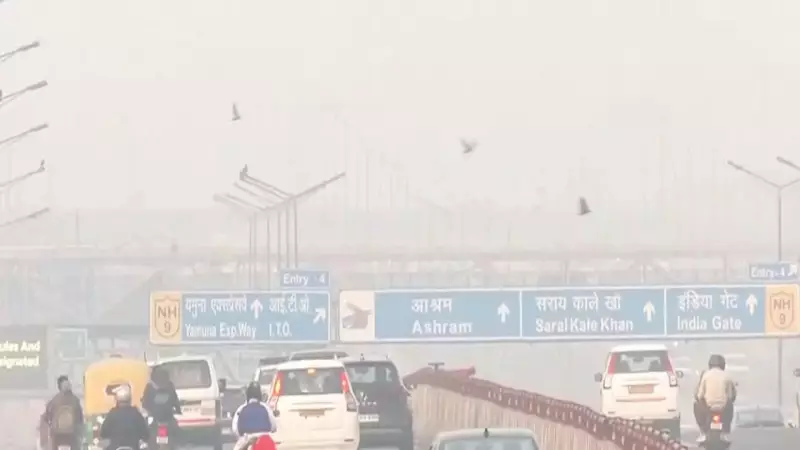
A dense and hazardous layer of smog engulfed India's national capital on Saturday morning, pushing the air quality back into the 'very poor' zone. Data from the Central Pollution Control Board (CPCB) recorded an average Air Quality Index (AQI) of 333 at 7 am, signaling a significant health risk for residents.
Visibility Drops, Key Areas Worst Hit
While the readings show a marginal improvement from the extreme levels witnessed in recent weeks, a thick haze severely reduced visibility across many parts of Delhi. Critical monitoring stations reported alarming figures. Anand Vihar and Ghazipur Mandi both recorded an AQI of 366, closely followed by Wazirpur at 359 and Sonia Vihar at 352. The Bawana area was the most polluted spot with an AQI of 375. Notably, the iconic India Gate and Kartavya Path were also shrouded in smog, with the local AQI measured at 311.
The CPCB classifies an AQI between 301 and 400 as 'very poor', a level where prolonged exposure can lead to respiratory illness. The 'poor' category, which includes NSIT Dwarka's reading of 260, spans from 201 to 300.

Government Response and Health Concerns Addressed
The persistent pollution crisis prompted a discussion in the Rajya Sabha. In response to a question from MP Dr. Laxmikant Bajpayee regarding media reports linking one in seven Delhi deaths to toxic air, the government provided a detailed reply on Friday.
Minister of State for Environment, Forest and Climate Change, Kirti Vardhan Singh, acknowledged various studies on air pollution's impact by academic institutes. He stated that in 2025, Delhi had not witnessed a single day of 'severe plus' AQI. The government highlighted the ongoing efforts led by the Commission for Air Quality Management (CAQM).
Ongoing Measures to Combat Pollution
The Commission, established under a 2021 Act, is the central body overseeing air quality in Delhi-NCR. Its multi-pronged strategy includes:
- Issuing 95 statutory directions to guide anti-pollution actions.
- Implementing a Graded Response Action Plan (GRAP) for the peak winter season.
- Enforcing stricter emission norms for polluting activities in the National Capital Region.
- Holding regular review meetings with stakeholders to monitor progress.
The government maintains that a collaborative approach with all major stakeholders is crucial to achieving sustained reductions in pollution levels across the region.






