

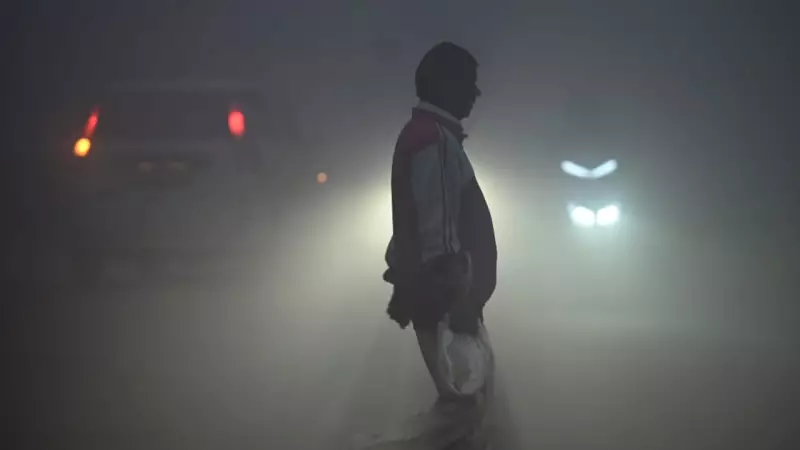
Delhi and the National Capital Region (NCR) woke up to another hazardous morning on Tuesday, December 16, 2025, as a thick blanket of toxic smog and dense fog severely reduced visibility and worsened air quality, disrupting daily life and travel across the region.
Air Quality: Marginal Improvement Amid Persistent Hazard
The overall Air Quality Index (AQI) for Delhi showed a slight improvement, settling at 377 in the 'very poor' category on Tuesday morning. This was notably better than Monday's reading of 498. However, the relief was minimal and unevenly distributed. Data from the Central Pollution Control Board (CPCB) revealed that 11 out of 40 monitoring stations still recorded air quality in the 'severe' category.
Areas like Jahangirpuri, Mundka, and Wazirpur were among the worst affected, with AQI levels as high as 426. In a concerning incident, the monitoring station in Rohini stopped transmitting data after reporting a maximum AQI of 500 for 19 consecutive hours, citing insufficient data for PM2.5 readings.

Transport Gridlock: Flight Delays, Speed Curbs, and a Tragic Pile-Up
The combination of fog and pollution created chaos on both air and road networks. The Indira Gandhi International (IGI) Airport issued a fog advisory, warning passengers of possible flight delays and disruptions due to low visibility. Airlines like IndiGo echoed the warning, advising travellers to check their flight status and plan for extra time.
On the roads, authorities imposed strict speed restrictions to prevent accidents. Key measures included:
- Yamuna Expressway: Speed capped at 75 kmph for light vehicles and 60 kmph for heavy vehicles.
- Noida-Greater Noida Expressway: Limits set at 75 kmph (light) and 50 kmph (heavy).
- Noida Elevated Road: Maximum speed restricted to 50 kmph for light vehicles and 40 kmph for heavy vehicles.
Despite these precautions, a major tragedy struck on the Yamuna Expressway in Mathura. In the early hours of Tuesday, a massive pile-up involving at least seven buses and several other vehicles resulted in four fatalities and over two dozen injuries. Police identified dense fog and near-zero visibility as the primary cause of the collision, which also saw some vehicles catch fire.
Health and Safety Advisories for Residents
With the AQI persistently in the 'very poor' to 'severe' range, health experts have reiterated urgent precautions for Delhi-NCR residents. The advisory strongly recommends:
- Minimizing outdoor activities, especially during early morning and late evening hours when pollution and fog peak.
- Wearing N95 or equivalent masks when stepping outside.
- Using air purifiers indoors and keeping windows closed.
- Avoiding strenuous exercise outdoors.
- Special care for children, the elderly, and individuals with pre-existing respiratory or cardiac conditions.
Meanwhile, the Graded Response Action Plan (GRAP) Stage IV restrictions remain in force across the capital in a bid to control emission sources. The situation underscores the severe and multifaceted challenge that winter pollution poses to public health, safety, and mobility in northern India.






