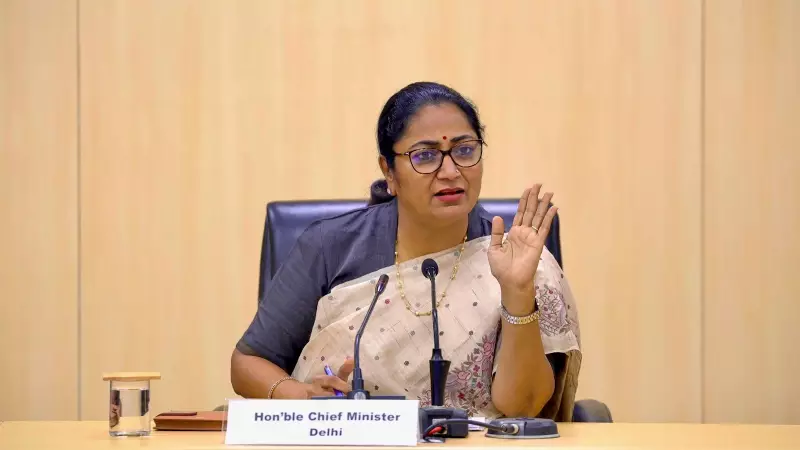
Delhi Chief Minister Rekha Gupta has issued a stark appeal to residents, stating that the city's air quality will not improve unless people abandon personal vehicles for public transport, especially when travelling alone. Her call comes as the capital's air quality is forecast to remain in the 'Very Poor' category until at least December 20, with conditions potentially worsening to 'Severe' over the following six days.
A Direct Appeal for Sustainable Commuting
Speaking at the inauguration of the new Delhi Metro Museum at the Supreme Court Metro station on Wednesday, CM Gupta highlighted the critical link between vehicular emissions and Delhi's toxic air. "When people talk about reducing pollution in Delhi, I tell them that a big contributor is transportation," she stated. She pointed to the immense pressure created by lakhs of vehicles, many operating without valid pollution certificates, in a densely populated area housing around 3 crore people.
"If we want Delhi to remain liveable, we have an obligation to use public transport," Gupta asserted. She urged a collective behavioural shift, adding, "That will only happen when all of us decide that we will not use a car if we are travelling alone, I will either carpool or use the Metro or a bus." This plea addresses a core urban challenge, with nearly 80 lakh vehicles registered in Delhi and a daily influx from neighbouring states pushing the total on Delhi-NCR roads to an estimated 2.88 crore.

Government Action and Persistent Pollution Forecast
Outlining her administration's efforts, the Chief Minister announced a decisive move towards green public mobility. A decision has been taken to completely convert the public bus fleet into electric vehicles. "We have already converted 3,500 of our buses to e-buses. By the end of 2026, we have set a target of converting all our buses to e-buses," Gupta revealed, promising a new electric vehicle policy soon.
Despite these measures, the immediate forecast remains grim. On Wednesday, Delhi's Air Quality Index (AQI) was recorded at 334 ('Very Poor'), showing only marginal improvement from Tuesday's 354, aided by stronger south-westerly winds. However, the India Meteorological Department (IMD) and air quality bulletins warn of deteriorating dispersion conditions. A ventilation index falling below 6,000 m²/s, coupled with low wind speeds, creates an unfavourable environment for pollutants to clear.
According to the IITM's air quality forecast, the AQI is likely to stay in the 'Very Poor' range until Friday, December 20. The outlook for the subsequent six days is even more concerning, with predictions ranging from 'Very Poor' to 'Severe'. The city had already endured 'Severe' air (AQI above 400) over the preceding Saturday, Sunday, and Monday.
Breaking Down the Pollution Sources
Data from the Decision Support System (DSS) for air quality management provides a detailed snapshot of the pollution load. On Wednesday, emissions from Delhi's transport sector accounted for approximately 16% of the city's pollution. Intriguingly, emissions originating from Jhajjar in Haryana were nearly identical, contributing 16.53%.
Other significant contributors included:
- Delhi and its peripheral industries: 8.06%
- Rohtak: 5.06%
- Residential emissions: 3.97%
- Gurgaon: 1.79%
The DSS forecast indicates a shifting dynamic, with Jhajjar projected to become a dominant regional polluter in the coming days, its contribution potentially soaring to 22.54% and overtaking Delhi's own transport sector emissions.
Meteorologically, while minimum temperatures are expected to stay near normal for the next three days before rising by about 2 degrees Celsius, the primary concern remains stagnant air. On Wednesday, Delhi recorded a minimum temperature of 10.4°C (2.3 degrees below normal) and a maximum of 24.7°C (2.5 degrees above normal). Morning shallow fog reduced visibility to 700 metres at Safdarjung and 800 metres at Palam, further complicating the pollution scenario.
The combined picture underscores CM Gupta's message: while government policy pushes for electric buses and cleaner technology, a significant part of the solution lies in the daily choices of millions of commuters to opt for sustainable transport.