

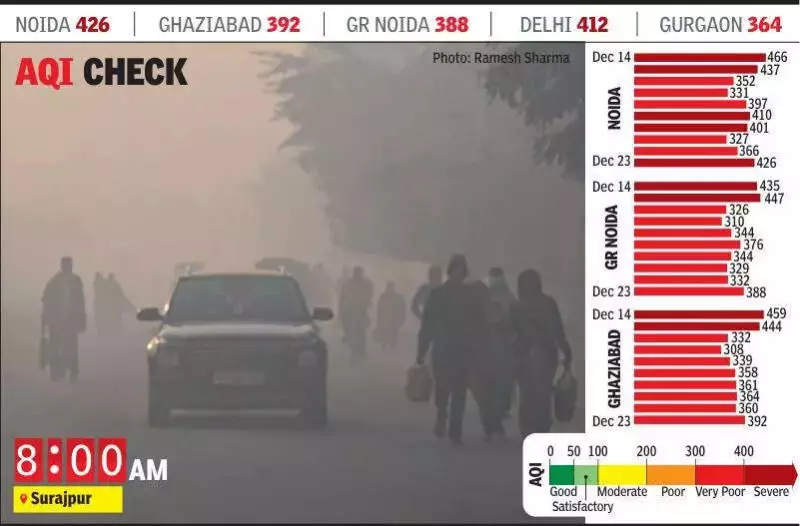
Air quality across the Delhi-National Capital Region (NCR) took a severe turn for the worse on Tuesday, with multiple cities slipping back into the hazardous 'severe' category after a brief period of slight improvement. The decline was attributed to a combination of poor ventilation, dense fog, and significantly low wind speeds that trapped pollutants close to the ground.
City-Wise AQI Plunge: Noida, Delhi Back in the Red
Noida witnessed a sharp deterioration, with its Air Quality Index (AQI) jumping to 426, squarely in the 'severe' zone, from 336 ('very poor') recorded on Monday. In Ghaziabad, the air quality inched closer to the severe threshold but remained in the 'very poor' category with an AQI of 392, up from 373. Greater Noida followed a similar trend, registering an AQI of 388 compared to 332 a day earlier.
The capital city, Delhi, experienced its fourth 'severe' air day this month after a break of seven days. The city's average AQI stood at 412, a significant worsening from the 373 ('very poor') recorded on Monday. Data revealed that out of 40 monitoring stations across Delhi, a staggering 27 recorded 'severe' air quality (AQI above 400). Five stations even entered the 'severe plus' category with an index above 450.

Pollution Hotspots: Anand Vihar Tops at 470 AQI
According to readings from the pollution control board's SAMEER app, several areas emerged as critical hotspots. In Delhi, Anand Vihar recorded the highest AQI at 470, followed by Nehru Nagar (463), Okhla (459), Mundka (459), and Siri Fort (450).
In Noida, Sector 1 recorded the highest AQI at 465, according to the Central Pollution Control Board (CPCB) portal. It was followed by Sector 116 (AQI 436) and Sector 125 (AQI 415) – all three in the 'severe' category. Sector 63, with an AQI of 386, was the only station in Noida in the 'very poor' range.
Greater Noida's Knowledge Park V recorded 'severe' air at 422 AQI, while Knowledge Park III was 'very poor' at 348. In Ghaziabad, Vasundhara was the most polluted location with an AQI of 499, perilously close to the maximum of 500. Other areas like Sanjay Nagar (384), Indirapuram (364), and Loni (346) recorded 'very poor' air quality.
Weather and Forecast: Winds Hold the Key
The Indian Institute of Tropical Meteorology (IITM) reported that the predominant surface wind on Tuesday was from the northwest, with speeds reaching up to 20 kmph during the afternoon. However, the wind speed later dropped to below 16 kmph in the evening, reducing the dispersion of pollutants.
The Centre's Air Quality Early Warning System (EWS) forecast an improvement to the 'very poor' category on Wednesday due to an expected increase in wind speed. Stronger winds help flush out accumulated pollutants. The forecast stated that winds from the northwest could reach up to 20 kmph in the afternoon before decreasing again in the evening.
A critical measure, the ventilation index – which indicates the atmosphere's ability to disperse pollutants – is expected to be 8,000 m²/s on Wednesday. However, it is predicted to fall sharply to 3,300 m²/s on Thursday and 1,500 m²/s on Friday over Delhi. An index lower than 6,000 m²/s with low wind speed is considered unfavourable for pollution dispersion.
Sources of Pollution: Transport and External Factors
Data from the Decision Support System (DSS), operated by the Ministry of Earth Sciences, provided a breakdown of PM2.5 sources for Tuesday. In Delhi, the transport sector contributed 14.4% to the net PM2.5 load, industries 7%, construction 2%, and residential emissions 3.5%.
Significantly, the data highlighted the role of external pollution sources. Neighbouring cities like Jhajjar in Haryana contributed 12% to Delhi's PM2.5 load, while Sonipat contributed 6.5%. The DSS also forecasted that the transport sector's contribution could rise to 17.5% and industries to 8.6% in the coming period.
The air quality across the region is expected to remain in the 'very poor' range until the end of the year, with meteorological conditions playing a decisive role in any short-term fluctuations.






