

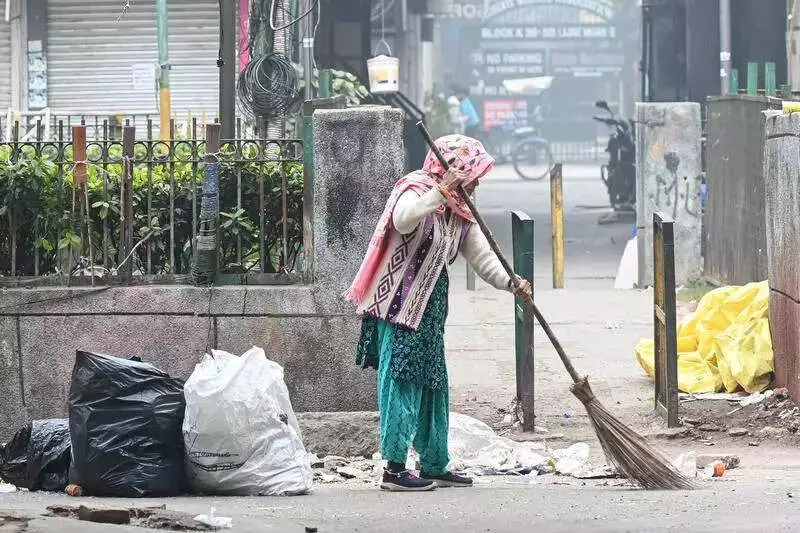
As the final day of the year dawned under a thick winter haze, New Delhi's Lajpat Nagar Central Market lay unusually quiet. By 7 am, while the city slowly stirred, 45-year-old Sukhbiri had already been at work for hours. Her day, like that of countless other sanitation workers, begins in the dark, a relentless routine set against the backdrop of the capital's toxic air.
A Pre-Dawn Battle Against Filth and Fumes
Sukhbiri wakes at 4 am in Palwal, Haryana, embarking on a long commute to reach her designated stretch in J Block by 5 am. Wrapped in a shawl that doubles as a makeshift mask against the dust, she sweeps the trash-lined sidewalks, accompanied only by stray dogs. The municipal corporation provides an apron once a year, but no gloves or proper masks are supplied, she states matter-of-factly. For these workers, the perennial debate over smog versus fog is irrelevant; they breathe in the polluted air regardless.
A few lanes away, 60-year-old Anita arrives from Madangir by 7:30 am without fail. A veteran of three decades of sweeping Delhi's roads, she now battles chronic bronchitis. Her 21-year-old son accompanies her, stepping in when breathlessness forces her to rest. Her recent regularization as a permanent employee guarantees a monthly salary of Rs 30,000, but she clarifies that the benefits largely end there.

Exhausting Commutes and Impossible Choices
The ordeal for these workers begins long before they pick up a broom. Many travel from the fringes of Haryana and Uttar Pradesh, where poor last-mile connectivity makes the commute itself an exhausting prelude to a day of hard labour. Vinod, 45, commutes from Noida and faces another hazard: soot from waste burnt overnight by locals to ward off the cold. The particulate matter triggers coughing fits and worsens his breathing, but with 11 family members to feed, he sees no alternative.
An MCD official cited the Solid Waste Management Rules, 2016, which mandate the provision of personal protective equipment like particulate masks with nose clips and gloves. The ground reality, however, mirrors Vinod's experience. If masks are provided at all, it is once a year, and gloves are even rarer.
Growing 'Immune' on Delhi's Deadliest Roads
The risks escalate dramatically along the capital's busiest arteries. Workers cleaning nearly 1,400 km of PWD-controlled roads are constantly exposed to direct exhaust fumes laden with PM2.5 and PM10 particles. Sohanveer, 51, who cleans August Kranti Marg, claims a grim acclimatization. "A few years ago, my nose would burn, my chest would feel heavy, but now I have become immune, I guess," he says with a sardonic laugh.
Official projections offer little hope for respite. The Commission for Air Quality Management (CAQM) forecasts that air quality will remain in the 'very poor' category until at least January 3, with minimal improvement thereafter. As the new year begins, the burden of Delhi's filth and its poisonous air continues to fall first and hardest on those tasked with cleaning it, armed with little more than resilience and a broom.






