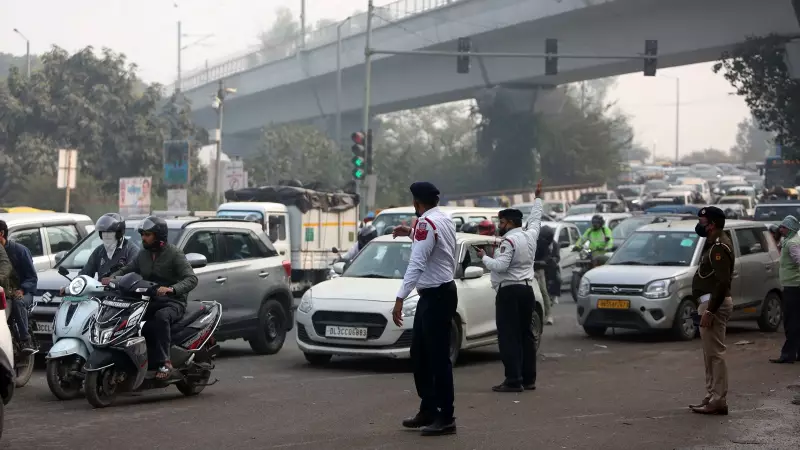
On a smoggy November morning, as most of Delhi grappled with 'very poor' air quality, a team of five traffic police officers began their gruelling shift at one of the capital's most notorious junctions. For these men at Kalindi Kunj, where traffic from Delhi, Noida, and Faridabad converges, the toxic air is not just a news headline but a daily occupational hazard, with severe personal health consequences now coming to light.
A Duty Station Choked with Fumes
By 7 am, the officers take their positions. One manages the Faridabad signal, another the Noida side, a third the Delhi stretch, while a fourth stands in the chaotic middle of the junction. A fifth officer manually controls the signals from a booth. Their primary shield against the relentless onslaught of vehicle emissions and dust is a single mask, a defence many find inadequate. A senior officer, serving since 1991, confessed, "I feel suffocated when I wear the mask for a long time." He labelled the duty at Kalindi Kunj the toughest of his career.
The physical toll is immediate and visible. As the officer removes his mask to blow a whistle, a speeding mini truck kicks up a cloud of dust, momentarily blinding him. For most of November 2025, the Air Quality Index (AQI) in Delhi hovered above 300. While government advisories pushed for staggered hours and work-from-home for office staff, such options are non-existent for these frontline workers.

The Invisible Health Scars Revealed
The senior officer's annual health check-ups have delivered alarming news over the past two years. "During my annual check-up over the last two years, the CT scan showed black dots in my lungs," he revealed. The discovery has worried his family deeply. "My son asks me to quit my job, but how can I?" he stated, highlighting the grim choice between health and livelihood.
His experience is not isolated but part of a systemic crisis for Delhi's outdoor workforce. A pivotal 2022 study by AIIMS Delhi and the TERI School of Advanced Studies examined outdoor workers like auto-rickshaw drivers, street vendors, and sweepers. It found widespread health issues including eye redness, headaches, and critically, limited lung function. The study noted that 39% of sweepers, 33% of auto drivers, and 27% of street hawkers tested had reduced lung capacity.
Seeking respite, the officer followed his doctor's advice to find cleaner air, embarking on a 15-day trip to Solan in Himachal Pradesh. "I felt lighter there, the air was clean and all my problems vanished," he recalled, adding wistfully, "I feel like just settling down there." His doctor's primary prescription wasn't medicine but the impossible advice to avoid polluted air and rely on masks and herbal concoctions (kadha).
Long Shifts and Systemic Challenges
Postings at Kalindi Kunj, though infrequent, involve marathon shifts from 7 am until 10:30 or 11 pm. Another officer with 39 years of service, including three in traffic police, detailed his ailments: a persistent cough, throat pain, and itchy eyes as pollution peaks in the evening. He pointed to potholes and litter exacerbating the dust, and mentioned requests for water sprinklers to visit the junction 3-4 times a day for dust suppression.
The root of the problem is intense congestion. Additional Commissioner of Police (Traffic) Dinesh Kumar Gupta explained that traffic from Noida in 5-6 lanes funnels into just 3 lanes at Kalindi Kunj, creating a bottleneck. In August 2025, he wrote to the National Highways Authority of India (NHAI) proposing a two-way flyover from Khadar Puliya to Noida to ease the flow. The NHAI responded that a Detailed Project Report would be prepared. Interim measures include road widening, preventing wrong-side driving with Noida Police, and issuing challans for pollution-under-control certificate (PUCC) violations.
As evening descends, the cumulative effect of noise, dust, and long hours weighs heavily. The senior officer described a sensation of ants scratching his head and dizziness setting in. The stress spills over at home, making him irritable. "My family says I should leave my anger at work… I try to wake up refreshed the next day, but what can I do…," he said with a half-smile.

These men soldier on, embodying a stark reality. "The whole of Delhi struggles, but we face it directly. Others can sit in offices; we stay on the road every time," the officer concluded. Their battle against toxic air continues with every breath and every blown whistle, a daily testament to the human cost of Delhi's pollution crisis.