

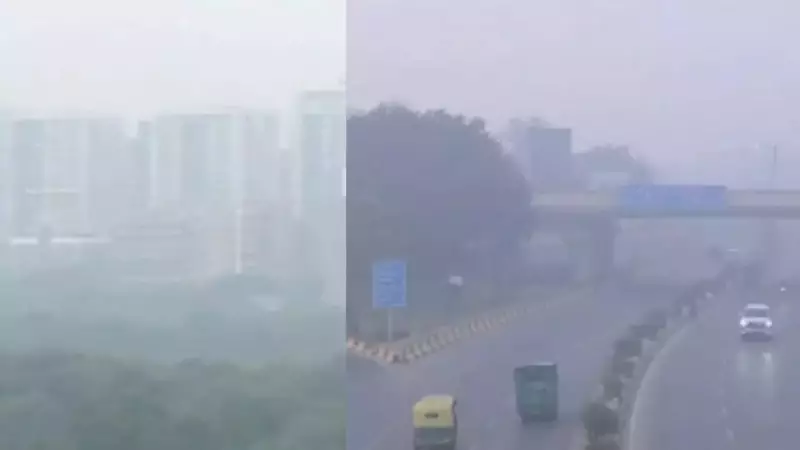
New Delhi grappled with a hazardous smog crisis on Sunday as a dense, toxic blanket enveloped the city, pushing air quality into the 'severe' zone. Multiple regions recorded dangerously high pollution levels, drastically reducing visibility and raising health alarms.
AQI Soars, Key Landmarks Disappear in Smog
According to data from the Central Pollution Control Board (CPCB), the overall Air Quality Index (AQI) for Delhi touched 391, firmly placing it in the 'severe' category. The situation was markedly worse in several specific localities. Morning visuals from the iconic Akshardham Temple showed the structure nearly vanishing into the thick haze, with the area's AQI soaring to 445.
Similarly, the ITO area was shrouded in poor visibility, its AQI crossing the 400 mark. The zone around the All India Institute of Medical Sciences (AIIMS) recorded an AQI of 340, which is categorized as 'very poor'. In a contrasting scenario, Mumbai's Bandra Kurla Complex witnessed moderate air quality with an AQI of 123, despite a light fog layer.

Authorities Swing Into Action, Enforce Curbs
In response to the escalating crisis, authorities have implemented Stage III measures under the Graded Response Action Plan (GRAP). These stringent steps include:
- Restrictions on construction and demolition activities.
- Halting certain industrial operations.
- Strict enforcement of the 'No PUC, No Fuel' rule at petrol pumps to curb vehicular emissions.
Officials pointed to a combination of adverse meteorological conditions—including cold temperatures, calm winds, and dense fog—as primary reasons for the pollutant buildup, trapping harmful particles close to the ground.
Health Warnings Issued as Poor Air To Persist
With weather patterns expected to remain unchanged in the near term, experts warn that the cycle of poor air quality is likely to continue. The Commission for Air Quality Management (CAQM) has issued advisories, especially for vulnerable groups.
Children, the elderly, and individuals with pre-existing respiratory or heart conditions have been urged to limit prolonged outdoor exposure. Wearing protective masks when outside is strongly recommended. The current episode underscores the persistent public health challenge posed by winter pollution in the national capital region.






