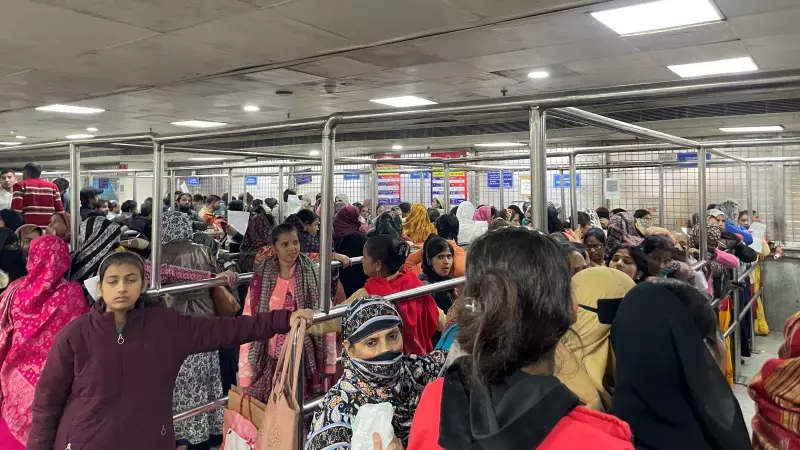
Delhi's battle with toxic air has taken a grim turn at its healthcare frontlines. The national capital's largest government-run hospital, Lok Nayak Jai Prakash (LNJP) Hospital, is grappling with a severe shortage of essential medicines needed to treat pollution-induced respiratory illnesses. This crisis unfolds as hospitals across Delhi report a 20% surge in outpatient numbers due to the deteriorating air quality.
Empty Shelves, Desperate Patients
Patients visiting the LNJP Hospital pharmacy are being turned away empty-handed. Essential drugs, including nebuliser solutions, various cough syrups, multivitamins, and critical inhalers, are conspicuously absent from the shelves. Pharmacy staff have been crossing out prescribed medicines on slips, marking them as "not available" and advising patients to purchase them from private chemists outside.
This situation hits the poorest citizens the hardest, as Delhi government hospitals are mandated to provide medicines free of cost. For many, the out-of-pocket expense for these drugs is a significant burden. A metered-dose inhaler (MDI) can cost anywhere from several hundred to over a thousand rupees.

Personal Stories of Hardship
The human cost of this shortage is stark. Nisha, a resident of Daryaganj, was told that the Bromhexine syrup and multivitamin syrup prescribed for her 7-year-old son, Naman, were out of stock. "You get nothing here, you have to buy medicines from outside," she lamented. Her son, ill for two weeks and suffering nosebleeds, needs the medicine urgently, but the family, reliant on her husband's school teacher income, struggles to afford it.
Prem Kumar, a 46-year-old security guard from Mayur Vihar, faced a similar ordeal. After waiting in line for over an hour, he was unable to procure his prescribed MDI Tiova inhaler, NAC 600 tablets, and Bromhexine for his persistent cough and breathlessness. "I will now have to pay to buy the medicines from outside," he said, worried about the extra financial strain. A single Tiova inhaler costs around Rs 535, while a strip of NAC 600 tablets is about Rs 330.
A Crisis Compounded by Toxic Air
The drug shortage coincides with one of the worst air pollution seasons in recent memory. According to Central Pollution Control Board (CPCB) data, Delhi's average Air Quality Index (AQI) deteriorated to 373 on Thursday, December 19, 2024. The air quality had slipped into the 'severe' category (above 400) on the preceding Saturday, Sunday, and Monday.
Since November 1, the daily average AQI has dipped below 300 on only five days combined in November and December. It has breached the 400-mark into the 'severe' zone on three days in each of these months, creating a public health emergency that is now exacerbated by the medicine shortage.
Systemic Procurement Failures
Sources within LNJP Hospital revealed that nebulisers, cough syrups, and several inhaler medicines have been unavailable for months. Only Asthalin, a brand of salbutamol used for asthma and COPD, is currently in stock. A Delhi health official disclosed that the last procurement of medicines for the hospital was in October, and that order constituted only about 25% of the actual requirement.
The official attributed part of the supply crunch to a systemic change: the government's decision to halt all local purchases of drugs and route everything through the Central Procurement Agency (CPA). This centralised tendering process, while intended for transparency and efficiency, appears to have created bottlenecks and delays in this critical period.
When approached for comment, both the LNJP Hospital administration and the office of the Delhi Health Minister chose not to issue any statement on the complaints regarding the drug shortage.
The confluence of hazardous air and a scarcity of life-saving medicines at a major public hospital underscores a critical failure in Delhi's preparedness for its annual pollution crisis, leaving its most vulnerable citizens to fend for themselves.