

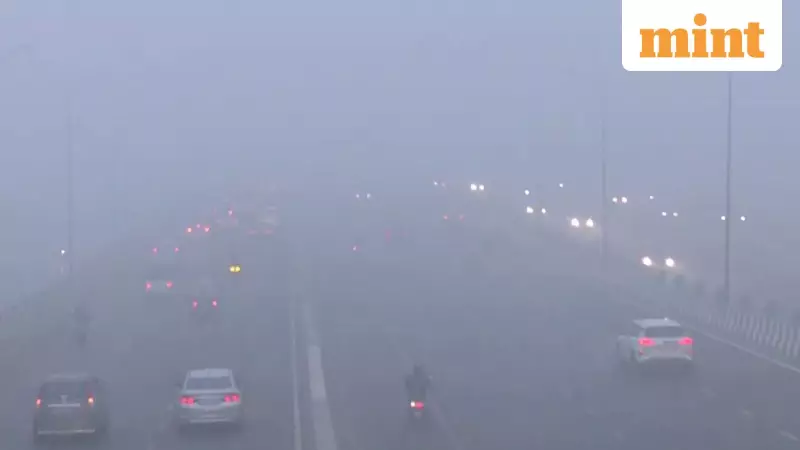
Residents of India's capital faced yet another morning shrouded in a thick, toxic haze on Tuesday, with air quality levels showing a marginal, grim improvement to the "very poor" category. The Air Quality Index (AQI) was recorded at 380, a slight reprieve from the "severe" zone that had choked the city for days.
A Slight Dip in a Sea of Smog
According to data from the Central Pollution Control Board (CPCB), Delhi's AQI stood at 378 at 8:00 AM on Tuesday. This comes after days of hazardous air, with readings exceeding 450 at several stations on Sunday, marking the worst levels this winter. On Monday, the AQI was 449. The shift to the "very poor" category (301-400) follows the implementation of GRAP Stage 4 restrictions, though the air remains dangerously polluted. The CPCB categorizes an AQI between 401 and 500 as "severe."
The Delhi government acknowledged that AQI levels had remained "severe" for at least three consecutive days. They warned that this level of pollution can cause respiratory issues even in healthy individuals and poses serious risks for people with existing heart or lung conditions.

The Deadly Toll of India's Air
The health implications of this chronic pollution are staggering. A 2024 study published in The Lancet linked long-term exposure to polluted air to 1.5 million additional deaths every year in India.
Further underscoring the crisis, the 2025 Air Quality Life Index (AQLI) report from the University of Chicago states that air pollution, India's most severe health threat, slashes the country's average life expectancy by 3.5 years. The report highlights that 46% of Indians live in areas exceeding the national PM2.5 standard. Delhi-NCR is among the worst-hit, with residents losing an estimated 4.74 years of life expectancy.
Globally, the State of Global Air (SoGA) Report 2025 identifies air pollution as the second-leading risk factor for early death. It attributed a staggering 7.9 million deaths worldwide in 2023 to air pollution.
Doctors Issue Urgent Health Warnings
Healthcare experts are urging extreme caution. Hospitals are reporting a surge in patients with breathing difficulties and eye irritation. Physicians have advised residents to avoid all outdoor activities.
"New Delhi is a gas chamber right now. Air purifiers can help only a bit, so it's high time the government comes up with some permanent solutions," said Dr. Naresh Dang, a physician at Max Healthcare.
Dr. Saurabh Mittal, Assistant Professor in Pulmonology at AIIMS, emphasized staying indoors as the primary precaution. "Children should play inside, and people should wear N95 masks if going out is unavoidable. Those with medical conditions should take their medicines regularly, and elderly people should take vaccines recommended by their doctors to reduce the risk of lung infections," he advised.
Despite the alarming statistics, activists point to a critical gap in accountability. Shweta Narayan of the Global Climate and Health Alliance noted, "Deaths related to air pollution are not being counted. And the reason why it's not being counted is that there are no systematic mechanisms to do so."






