

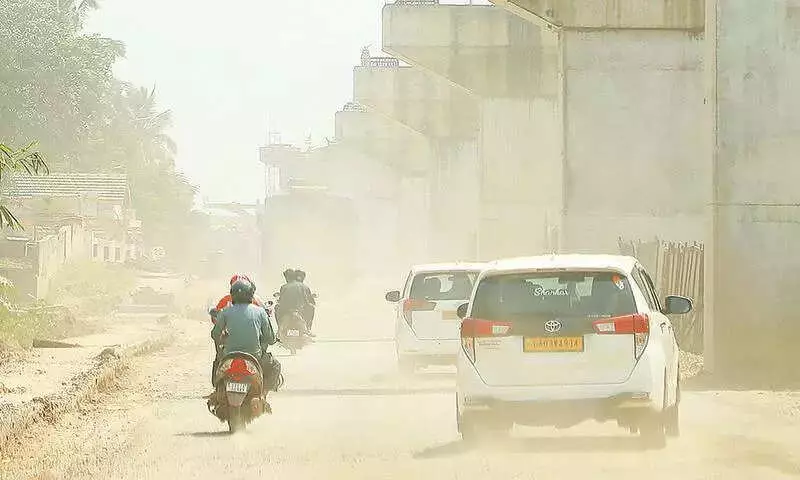
For musician Francisco D’Costa, the annual walking pilgrimage from Porvorim to Old Goa for the feast of St Francis Xavier was a sacred tradition. This year, that deep devotion was shattered not by a lack of faith, but by the very air he breathes. The 35-year-old, instead of walking, found himself gasping with chest congestion. His doctor's first, serious question was a shocking one: "Have you started smoking?"
The Shocking Math of Polluted Air
The doctor's query was based on a grim new reality. Open-source data reveals that regularly breathing the air in Goa's capital, Panaji, or the nearby legislative hub of Porvorim, is mathematically equivalent to smoking 3.2 cigarettes every single day. That amounts to 96 cigarettes a month for simply living and breathing in the area. The culprit is the dangerously high concentration of PM2.5—fine particulate matter so small it bypasses the lung's defenses and enters the bloodstream.
The World Health Organisation (WHO) sets the annual safe limit for PM2.5 at a mere 5 micrograms per cubic metre. Panaji's current average is a staggering 88 micrograms per cubic metre, a level nearly eighteen times above the international health guideline. This catastrophic decline has seen Panaji's rank among the world's most polluted cities drop to 321st, with its annual Air Quality Index (AQI) for 2025 worsening by 84.3% compared to five years ago.

A Health Emergency Unfolds
Doctors across Goa are witnessing the direct health consequences of this environmental collapse. ENT surgeon Dr Ehrlson De Sousa confirmed a surge in patients with respiratory ailments, a crisis he predicted a year ago. While he acknowledges contributing factors like seasonal field burning and post-pandemic viruses, Dr De Sousa states the overwhelming addition of construction dust is undeniable.
The human cost is immediate and severe. Ninoshka Lobo reports her mother, a senior citizen living near Mall de Goa, has suffered a sore throat for a week. "We just don't let her go out of the house because of this dust," Lobo said. The health risks are now categorised as extreme, linked to heart disease, skin issues, and severe asthma symptoms including intense wheezing and significant chest tightness.
Failed Measures and Public Outcry
Despite directives from the Goa State Pollution Control Board (GSPCB) to contractors for the elevated corridor project to implement dust mitigation measures, the situation remains dire. Only 0.6% of days in 2025 met WHO's safe air quality limits in Panaji and Porvorim. This is a devastating statistic for a state that markets its pristine environment as a key asset.
A local businessman voiced the collective anxiety, noting, "Air quality in Panaji is very low at 172. Our only USP of Goa is going bad. Can we still invite investors and startups to Goa claiming that the air is clean?" Residents like D'Costa have altered their lives, giving up outdoor exercise like going to the gym. Others, like Neil D'souza and his wife Joyner Mesquita, are forced to work while sick as their leave runs out, exposing themselves daily to hazardous air.
Doctors warn that when AQI levels hover in the unhealthy range (150-301), the risk of severe asthma symptoms is high. These can include intense wheezing, shortness of breath, chest tightness, and persistent coughing, severely disrupting daily life. The call from Goans is now for decisive and effective action to control large-scale construction pollution before the state's health and its reputation suffer irreversible damage.






