

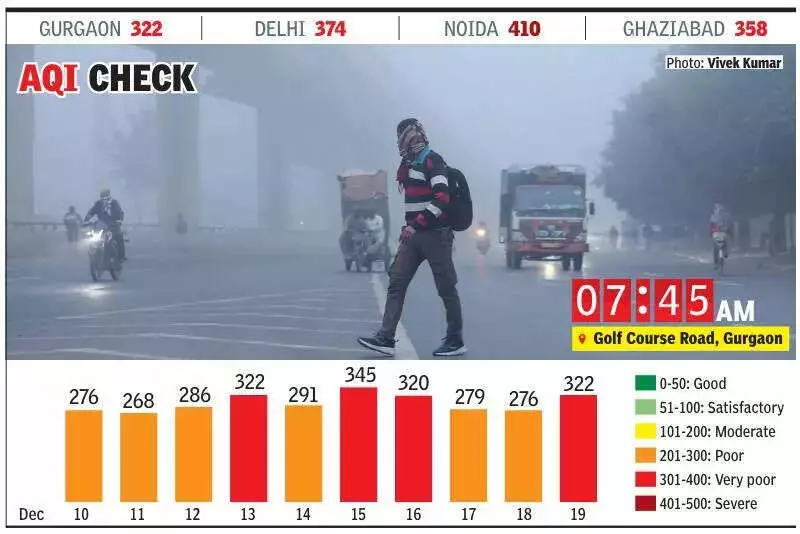
Gurgaon's air quality took a sharp turn for the worse on Friday, slipping back into the hazardous 'very poor' category after a brief two-day spell in the 'poor' range. The city's average Air Quality Index (AQI) was recorded at a concerning 322, as per data from the Central Pollution Control Board (CPCB).
Monitoring Stations Paint a Grim Picture
All four operational air quality monitoring stations in the city reported alarmingly high levels of pollution, with fine particulate matter (PM2.5) identified as the dominant pollutant. The situation was most severe at the NISE Gwal Pahari station, which registered an AQI of 381. Sector 51 followed with 332, and Teri Gram recorded 306, all firmly in the 'very poor' bracket. Vikas Sadan reported a slightly lower, yet unhealthy, AQI of 260, placing it in the 'poor' category.
This deterioration comes after a marginal improvement earlier in the week, where readings of 279 on December 17 and 276 on December 18 were noted. However, the city has largely oscillated between 'poor' and 'very poor' levels throughout December, frequently breaching the 300-mark. The highest pollution level this month was recorded on December 15, when the average AQI soared to 345.

Health Experts Sound the Alarm
Medical professionals in Gurgaon are witnessing a direct impact of the toxic air on public health. Dr. Bandana Mishra, a consultant in Pulmonology and Respiratory Medicine at Manipal Hospital, Gurgaon, confirmed a noticeable surge in patients with respiratory illnesses.
"This dusty environment is not good for the respiratory system. We are seeing more patients than usual," Dr. Mishra stated. She highlighted that while asthma is common in young people, asthma-like symptoms are now appearing frequently among the elderly and children during this polluted period.
She explained that stagnant weather conditions trap dust, increasing levels of nitrates, carbon monoxide, and particulate matter (PM2.5 and PM10). "Dust accumulates in the lungs and can impair its function, leading to asthma, allergies, and bronchitis. Even patients with no prior history are reporting breathlessness, wheezing, and cough. Cases of pneumonia have increased, and COPD patients are suffering from recurrent infections," she added.
Doctors have issued urgent advisories, urging residents, especially those with pre-existing conditions, to:
- Limit outdoor exposure as much as possible.
- Wear protective masks (like N95) when stepping outside.
- Avoid smoking and areas with smoke.
- Ensure timely medication and recommended vaccinations.
Weather to Blame, Relief Not in Sight
Officials have attributed the recent spike in pollution to unfavourable meteorological conditions. Low wind speeds, frequent fog, and poor dispersion of pollutants have created a toxic blanket over the city. Forecasts from the Decision Support System (DSS) and the India Air Quality Early Warning System suggest no immediate respite.
The prediction for the coming days indicates weak surface winds, mostly below 10 kmph, accompanied by moderate to dense morning fog. These conditions are expected to keep the boundary layer shallow, effectively trapping pollutants close to the ground and preventing their dispersal. Residents must brace for continued poor air quality in the immediate future.






