

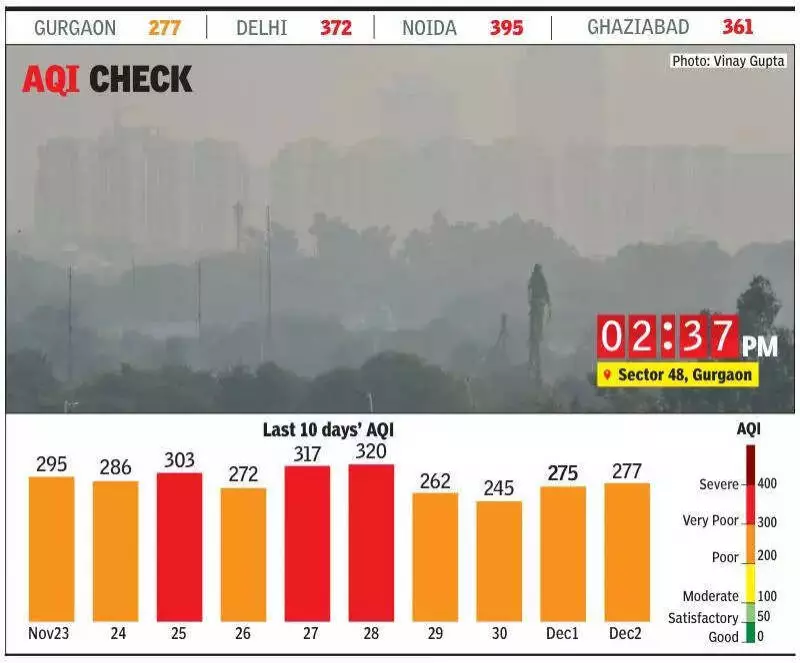
The air quality in Gurgaon took a turn for the worse on Tuesday, with the city's overall Air Quality Index (AQI) climbing to 277, firmly in the 'poor' category. This marks a slight but concerning increase from the 275 recorded on Monday. The situation is more alarming at the local level, where three out of the four Central Pollution Control Board (CPCB) monitoring stations in the city have already entered the 'very poor' zone.
Monitoring Stations Paint a Grim Picture
Data from the CPCB stations revealed stark readings. The worst-hit areas were NISE Gwalpahari and Teri Gram, both recording an AQI of 327. They were closely followed by Sector 51, which registered 301. Both these figures fall squarely in the 'very poor' category. A lone spot of relative relief was Vikas Sadan, where the AQI reading was 159, categorized as 'moderate'.
Health advisories accompanying these readings issued clear warnings. They stated that sustained exposure to AQI levels in the 'poor' and 'very poor' categories can trigger breathing discomfort for most of the population. The risks are significantly higher for individuals suffering from asthma, heart disease, or other chronic respiratory illnesses.

Weather Holds the Key for the Coming Days
Officials from the Haryana State Pollution Control Board (HSPCB) indicated that the fate of the region's air quality over the next 72 hours will largely depend on winter's tightening grip. As temperatures drop and wind speeds ease, the atmosphere becomes more stable, creating a lid-like effect that traps pollutants close to the ground.
In such conditions, two meteorological indicators become critical:
- Mixing Height: This refers to the vertical height in the atmosphere available for pollutants to disperse. A higher mixing height allows for better dilution.
- Ventilation Index: This combines mixing height with wind speed. A value above 6,000 m²/s is considered necessary for effective pollution clearance.
Current forecasts are not encouraging. The Decision Support System projects that mixing heights over Delhi-NCR will fall from 1,150 metres on December 2 to around 1,000 metres on December 4 and 5. Simultaneously, the ventilation index is forecast to remain between 2,500 and 5,200 m²/s from December 2 to 5, all values well below the safe threshold of 6,000 m²/s.
Delhi's Air Quality Follows a Similar Downward Spiral
The pollution crisis was not confined to Gurgaon. In the national capital, the air quality deteriorated sharply into the upper reaches of the 'very poor' category. Delhi's average AQI was recorded at 372 at 4 PM, considered the day's standard reading, a significant jump from 304 a day earlier. It worsened further, reaching 390 by 8 PM.
The deterioration was widespread. Chandni Chowk emerged as an early hotspot, slipping into the 'severe' category with a reading of 404 at 9 AM, which soared to 450 by 4 PM. By late afternoon, 14 out of 39 monitoring stations in Delhi were showing 'severe' air quality levels. Even typically cleaner areas were not spared. IHBAS Dilshad Garden, a station located in a green zone with minimal traffic, witnessed a steep spike to an AQI of 383 at 9 AM.
An HSPCB official summarized the grim outlook, stating, "When wind speeds drop and the mixing height collapses, the pollution load simply sits over the city. Even small emissions start showing up as sharp spikes. The coming days look unfavourable, and we expect air quality to slip into the very poor category."
According to forecasts from the Centre's Air Quality Early Warning System, the AQI in Delhi is likely to remain in the 'very poor' category from December 3 to 5, with the outlook for the subsequent six days also pointing to persistently poor air quality.






