

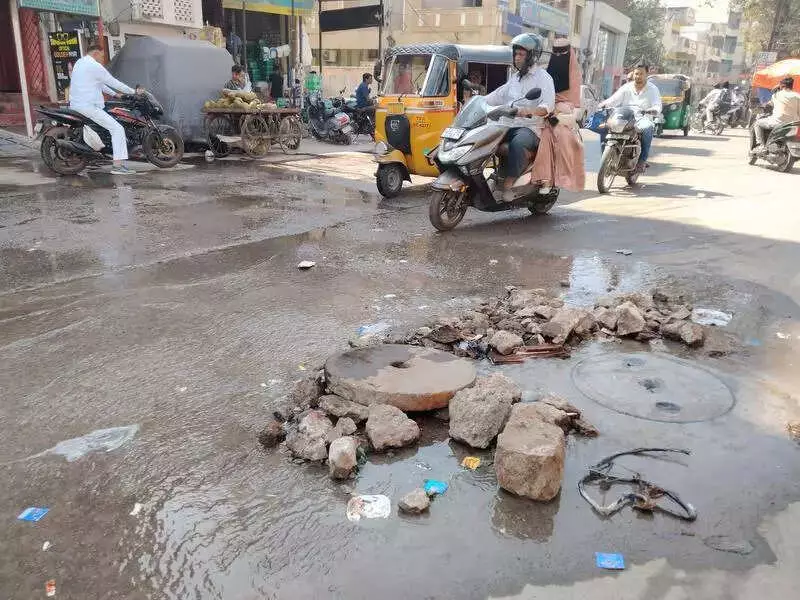
Hyderabad is facing a severe public health emergency due to its crumbling water supply infrastructure, with experts warning the city is sitting on a ticking time bomb. The network, riddled with hundreds of cracks and weakened joints, has already been linked to two contamination incidents in 2009 and 2022, mirroring the recent tragedy in Indore that claimed 16 lives.
Decaying Infrastructure and Staggering Water Loss
The scale of the problem is monumental. Nearly 20 million gallons per day (MGD) of precious drinking water are lost due to leaks across the metropolitan area. This highlights the fragile and aged state of the supply system. Ironically, Hyderabad's official leakage rate is around 4%, which is well below the permitted loss of up to 15% under non-revenue water standards, yet the physical reality tells a story of widespread decay.
Much of the city's water and sewerage infrastructure is decades old. Pipelines originating from key sources like Gandipet, Manjeera, and Singoor frequently report breaches. A critical example is in Manjeera, where pre-stressed concrete (PSC) pipelines laid in the 1960s have deteriorated after surpassing their expected lifespan of about 60 years. These ageing conduits are so prone to leakage under high pressure that the Hyderabad Metropolitan Water Supply and Sewerage Board (HMWSSB) is forced to operate them at reduced capacity.

Imminent Contamination Risks and Reckless Excavation
Urban planners and public health experts raise a red flag, stating that ageing pipelines and undetected leaks drastically increase the risk of sewage seeping into the drinking water supply. This risk escalates during periods of low pressure. They caution that Hyderabad is in a state of perpetual vulnerability, where even minor operational errors or pressure fluctuations could trigger a contamination event, allowing dangerous pathogens like E. coli to infiltrate the water lines.
"High-level quality control, extraordinary precautions and specialised supervision during the implementation of water and sewerage systems, especially at local and micro levels, along with responsible contractor practices and active citizen oversight, can minimise risks and ensure public health and safety," emphasized a senior urban planner.
Compounding the problem is the unregulated excavation and drilling for projects like road widening and laying utility cables. Veda Kumar, chairman of the Deccan Heritage Academy, pointed out that contractors often work without knowing the location of underground utilities. "This can result in accidental damage, cross-contamination and leaks. Consumers remain unaware that they are consuming contaminated water until they fall ill with diarrhoea, fever or other waterborne diseases," he said.
HMWSSB's Urgent Two-Month Overhaul Plan
Acknowledging the gravity of the situation, HMWSSB managing director Ashok Reddy recently admitted to receiving daily complaints about contaminated water. He has directed officials to compile detailed, division-wise data on outdated pipelines and map areas with repeated contamination complaints.
Based on this assessment, the condition of pipelines in critical zones will be evaluated and replacement plans prepared without delay. Reddy has instructed officials to immediately initiate proposals for replacing old pipelines with new ones and submit a comprehensive action plan. He stressed that this pipeline replacement work is a matter of utmost urgency and must be completed within the next two months.
To aid this effort, the board is deploying advanced technology. "We have deployed pollution identification machines, also known as pipe inspection camera systems, which use robotic technology to detect leaks and contamination inside pipelines. This will help us to identify and resolve problems efficiently and early on," stated a senior HMWSSB official.
The race to overhaul Hyderabad's water network is now on, with the city's health and safety hanging in the balance against the clock and its decaying pipes.






