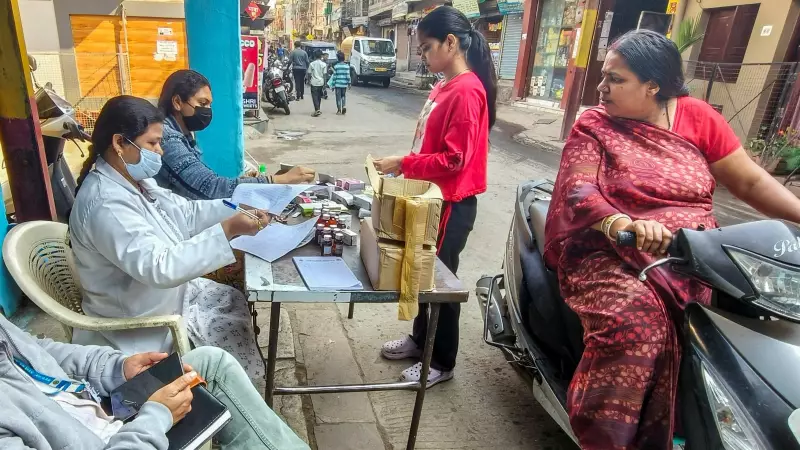
In the cramped bylanes of Indore's Bhagirathpura, a tragedy has unfolded, claiming at least ten lives and hospitalising hundreds after residents consumed contaminated municipal water. As the city grapples with the aftermath, a massive investigative operation involving 200 personnel is racing against time, not just to fix the system but to unravel a disturbing mystery: the exact source of the deadly contamination remains elusive.
A Citywide Hunt for the Culprit
The initial investigation pointed to a seemingly straightforward cause. A police chowki's toilet, built directly over a main water pipeline in Bhagirathpura, was identified as the prime suspect. With no proper septic tank, waste accumulated in a pit, potentially seeping into the water supply through a broken pipe. However, investigators are now casting a wider net. A senior area engineer overseeing the probe stated that while the toilet remains a factor, the team is actively looking beyond that single source.
The scale of the response is unprecedented. Following a high-level meeting with Chief Minister Mohan Yadav and amid political pressure, municipal teams are fanning out across Indore. Their mission is multi-pronged: from conducting heavy metal tests on pipelines to physically descending into the city's sewerage access chambers. Teams are tasked with cleaning and inspecting 1,000 such chambers, a process taking 20 minutes per chamber, to hunt for leaks or structural failures that could allow sewage to mix with water mains.
Ground Realities and Mounting Challenges
The operation is fraught with logistical hurdles, especially in the epicentre of Bhagirathpura. The area is a maze of narrow lanes, barely eight feet wide, where vehicles cannot pass, forcing engineers to carry equipment by hand. Compounding the difficulty is the need to trace work done by private vendors and avoid damaging other infrastructure like broadband lines during excavations.
Above ground, the focus has shifted to the city's 105 water tankers, a critical part of the supply chain. Authorities are testing water in all tankers for chlorine levels and bacterial infection. An assistant engineer explained the rationale: if contamination was widespread, it would have appeared in tankers across the city. Its confinement to Bhagirathpura suggests a localised, yet complex, source.
The human cost is stark. Health department data reveals that since December 24, 310 patients have been hospitalised, with 203 still receiving treatment, 107 discharged, and 25 fighting for their lives in intensive care units. On the ground, distrust lingers. Residents like Rahul from Chirag Mohalla express uncertainty, saying, "I am still unsure what all I have in my stomach from the past few days." Municipal worker Kishore highlighted the ongoing struggle, noting that even tap supply has stopped, forcing families to rely on tankers or buy bottled water for children.
Political Fallout and Administrative Response
The crisis has ignited political tensions. Opposition Congress leaders faced protests during a visit to Bhagirathpura, with scenes of pushing, shoving, and overturned motorcycles. Congress leader Sajjan Singh Verma demanded substantial compensation for victims' families, while BJP spokesperson Shivam Shukla denied party involvement in the protests, attributing them to public rejection of Congress politics.
Administratively, the strategy has evolved from a pinpoint search to a risk-based approach. Municipal engineers are now mapping areas with dense populations, pipelines older than 20 years, and lines running close to drains to prioritise inspections. The High Court has intervened, ordering the provision of water tankers to affected areas, leading to the deployment of four additional tankers to supplement the existing thirty.
As engineers continue their painstaking search through sewers and pipelines, the people of Bhagirathpura wait for answers and clean water, their lives upended by a failure in the city's most essential service.