

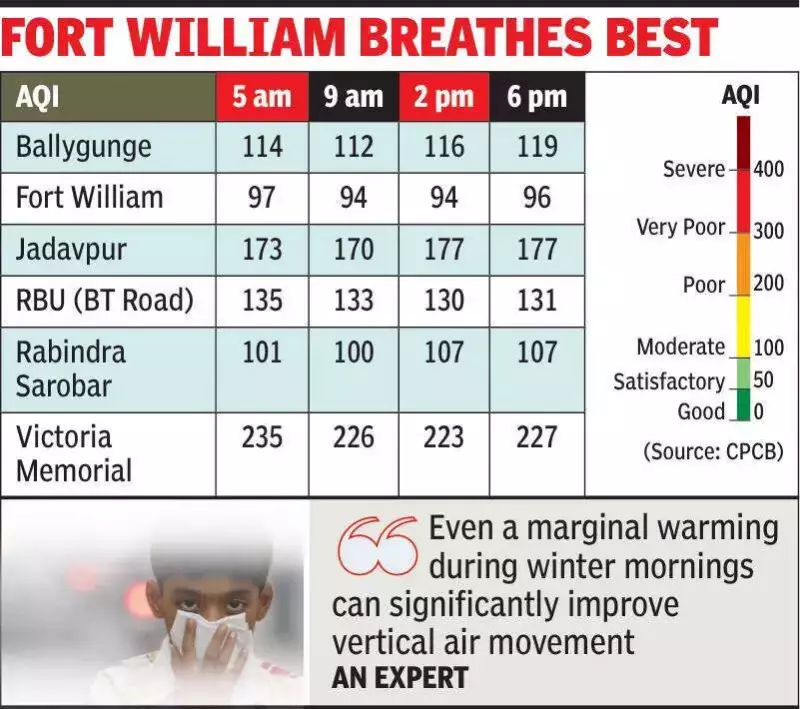
Residents of Kolkata experienced a welcome respite from the choking winter smog on Monday, as pollution levels eased across large parts of the city. Meteorologists linked the improvement to a slight increase in temperature, which helped disrupt the winter inversion layer that traps pollutants close to the ground.
Temperature Rise Breaks the Smog Trap
The key factor behind the cleaner air was a measurable rise in mercury. The minimum temperature in the city climbed by approximately 1 degree Celsius to settle at 16.2°C, while the daytime maximum saw a sharper increase of nearly 1.5 degrees, reaching 27.7°C. This marginal warming is crucial, as it enhances vertical air movement, preventing the dangerous buildup of fine particulate matter like PM2.5.
AQI Data Shows Widespread Improvement
Data from the Central Pollution Control Board (CPCB) confirmed the positive trend. Four out of the city's six active Continuous Ambient Air Quality Monitoring Stations (CAAQMS) recorded readings in the 'moderate' category (AQI 101-200). The stations at Ballygunge, Rabindra Sarobar, Jadavpur, and RBU (BT Road) remained in this zone throughout the day with stable readings.

The most significant turnaround was observed at the Fort William station. Its Air Quality Index (AQI) dropped below 100 for most of the day, placing it in the 'satisfactory' category. This improvement is particularly timely as Fort William is the focal point for the upcoming Vijay Diwas commemorations on December 16, with events starting Monday. The program includes a Bangladeshi delegation, a military tattoo, and wreath-laying at Vijay Smarak to honour the heroes of the 1971 war.
Victoria Memorial Remains a Concern
However, not all areas shared in the relief. The CAAQMS at Victoria Memorial Hall continued to register 'poor' air quality, with AQI levels stubbornly above 220 all day. Experts pointed to localized factors such as heavy traffic congestion, dust resuspension from the grounds, and stagnant air pockets as likely reasons for this anomaly, despite its proximity to the cleaner Fort William zone.
A Temporary Respite, Not a Solution
While health officials termed the overall improvement as encouraging, they issued a note of caution. They emphasized that even 'moderate' air quality poses risks for vulnerable groups, including children, the elderly, and individuals with pre-existing respiratory or cardiac conditions.
An air-quality expert summarized the situation, stating, "This is a window of relief, not a resolution." The comment underscores the need for sustained, long-term measures to control vehicular emissions, construction dust, and other pollution sources, especially during the peak winter months when meteorological conditions are unfavourable. The Met office has forecast that temperatures could remain steady on Tuesday.






