

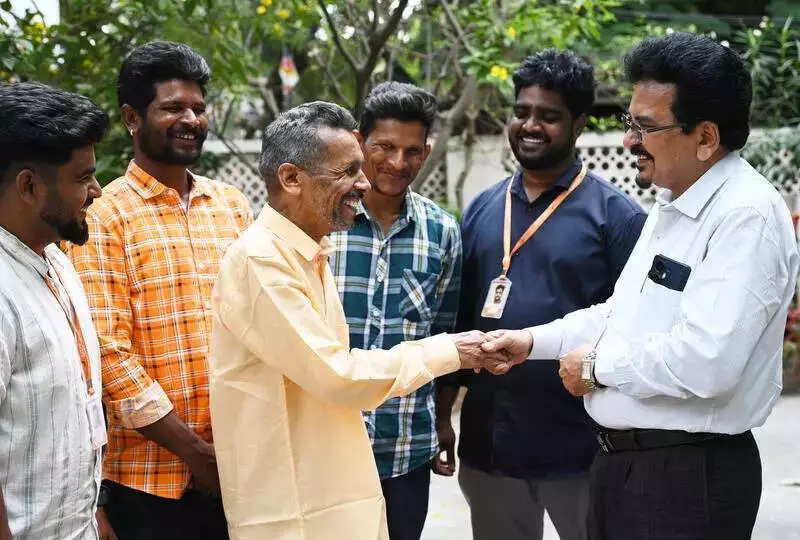
A successful reunification effort in Madurai has evolved into a broader administrative push to provide crucial documentation for homeless individuals with disabilities. The district administration's follow-up to reuniting a 51-year-old man with schizophrenia with his family in Madhya Pradesh is now setting a precedent for systemic support.
From Streets to Rehabilitation and Reunion
Arjun D was found on the streets of Madurai approximately four years ago by the M S Chellamuthu Trust and Research Foundation. He had arrived in the city by train from Indore. K S P Janardhan Babu, the foundation's director of programmes, stated that Arjun was diagnosed with schizophrenia and had been living at their rehabilitation home since his rescue.
As his condition improved over the years, Arjun actively contributed within the facility. He took on various roles including watchman, gardener, and food server, earning a modest income for himself during his four-year stay.

The Challenge of Tracing Family and Official Documentation
Locating Arjun's family proved difficult as his parents were no more. Jegan, the project lead at the NGO, explained that after extensive time and research, and with crucial assistance from another NGO based in Bombay, they were finally able to identify his relatives.
This week, Arjun's nephews, Shivji M and Balveer, both daily wage earners from Khargone in Madhya Pradesh, traveled to Madurai. After the district administration verified their identities, the emotional reunification was arranged.
District Collector K J Praveen Kumar highlighted a critical hurdle: Arjun lacked any official documents. To ensure his eligibility for government welfare schemes in his home state, the administration proactively arranged for his Aadhaar card and disability certificate. "Reunification is always challenging, and it is important to ensure the safety of the individual and that sustained family support is ensured," Kumar told TOI.
Scaling Up: A Broader Initiative for the Homeless
Inspired by this case, the administration is now focusing on a larger initiative. A medical health camp will be organized in Aruldaspuram. Janardhan Babu estimates that around 150 mentally ill individuals from their NGO will benefit from this camp.
A key component of this push is documentation. New Aadhaar cards will be issued with the NGO's address, which can later be updated with the individual's permanent home address once they are reunited with their families. Janardhan Babu shed light on a tragic reality, noting that mentally ill individuals often travel to pilgrimage sites like Madurai hoping for at least one meal a day, and are sometimes abandoned there by their own families.
The reunification brought immense relief to Arjun's family. His relative Shivji shared that Arjun would sometimes not return home for two to three years, leading them to assume he was managing on his own. "When we saw him now, he was ready to go home as he picked his packed bags even before we could call him," Shivji said, indicating Arjun's eagerness to return.
This single act of reunification has thus catalyzed a significant step towards providing identity and access to welfare for some of society's most vulnerable, homeless persons with disabilities.






