

In Mumbai, a 34-year-old woman named Sia found herself bombarded with sexually explicit messages from unknown numbers. It was only after police intervention that she discovered the source: her estranged husband had posted her personal details, including her name, phone number, and address, on a pornographic website. This act of malicious exposure, known as doxxing, marked her as a victim of a disturbing modern crime.
The Hidden Epidemic of Digital Abuse
Public health experts are now identifying cases like Sia's and others under a more precise label: survivors of technology-facilitated abuse in intimate relationships. This form of digital violence is gaining alarming traction. Another harrowing instance involves Sujata, a 20-year-old rape survivor from Pune. She was lured by a man on a dating app who used false promises of marriage and threats of violence. After he ghosted her, the trauma led her to a desperate act of self-harm in Bandra.
Counsellors at the Dilaasa centre in BMC-run Bhabha Hospital, where Sujata was taken, recognized she was not merely heartbroken but a victim of a serious crime. The perpetrator had concealed his real identity on the app. With one in three women over 15 facing some form of violence, experts estimate millions are likely suffering from digital violence, though awareness remains critically low and legal frameworks are still catching up.

From Surveillance to Extortion: The Many Faces of Digital Violence
Mrudula Sawant, a senior counsellor at Dilaasa, explains that many cases are subtle and never reported. These include husbands who constantly monitor their wives' texts, track their location via GPS, and interrogate them about old social media photos. Other manifestations are more overt, such as women being forced to pay ransom to prevent the spread of false information online.
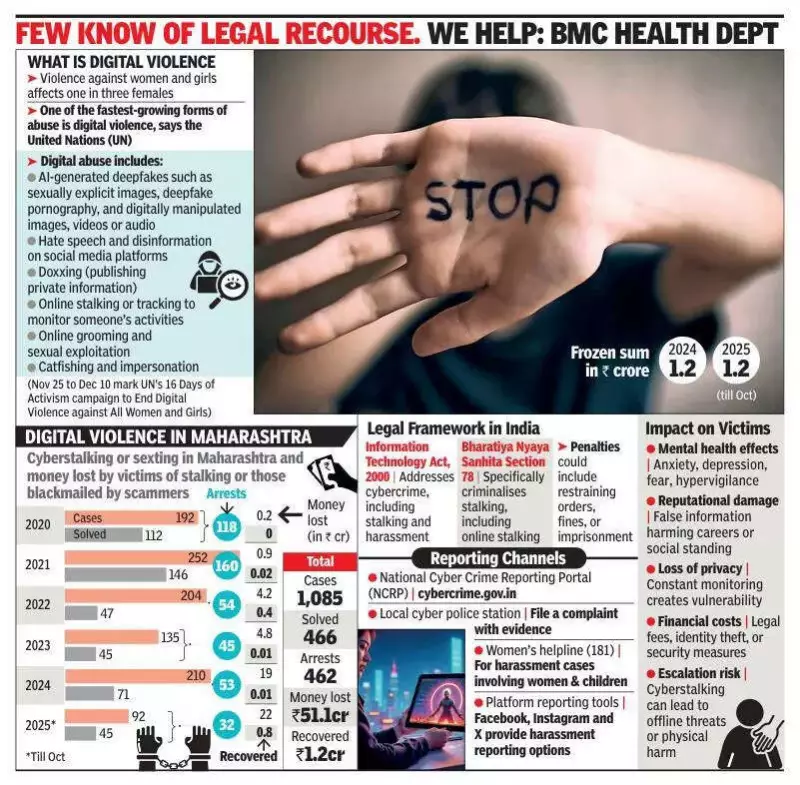
The financial toll is staggering. Maharashtra State Cyber Cell data reveals that in just the last 22 months, scammers extorted Rs 41 crore by blackmailing women they stalked online. A broader timeline from January 2020 to October 2025 shows 1,085 women in Maharashtra fell victim to cyberstalking or sexting, with Rs 51.1 crore siphoned off. Police have managed to recover Rs 1.24 crore and freeze another Rs 2.4 crore in the same period.
Anirudh Narayanan from CEHAT, which collaborates with BMC on Dilaasa centres, notes counsellors began observing an uptick in digital violence cases about two years ago. Their helpline receives regular calls, and intervention centres see one or two such patients monthly.
Why Is This Trend Accelerating?
Cyber criminals have identified a lucrative opportunity. A cyber police officer noted that while initial demands were small, extortion amounts skyrocketed to Rs 19 crore in 2024 and Rs 22 crore in 2025. Deputy Inspector General (State Cyber) Sanjay Shintre explained the modus operandi: scammers meticulously study social media profiles, send friend requests, and upon acceptance, gain access to the victim's network and activities. They then create morphed images or fake pornographic content for blackmail.
Former IPS officer Y P Singh points out that increased physical policing and CCTV surveillance have made traditional stalking riskier, pushing predators online. He advises the fundamental precaution of ignoring friend requests from strangers, as stalkers use these to initiate contact for either fake intimacy or creating compromising material for extortion.
The impact extends beyond emotional trauma to include financial violence. Researcher Pratikshya Priyadarshini highlights how abusers now exploit digital payment tools, linking a partner's bank account to apps like GPay and transferring money without consent. Seeking recourse remains difficult, as victims often don't know where to turn when their details are splashed across social media.
As BMC executive health officer Dr. Daksha Shah states, when women reach intervention centres, the focus is on providing emotional support and guiding them through legal pathways. However, as the case of a 17-year-old girl manipulated and assaulted by an elderly neighbour via Instagram shows, family support is not always forthcoming, making the path to justice even steeper.

The stories of Sia, Sujata, and countless others underscore an urgent need for greater public awareness, robust legal definitions, and supportive systems to address the pervasive and evolving threat of digital violence in India.





