

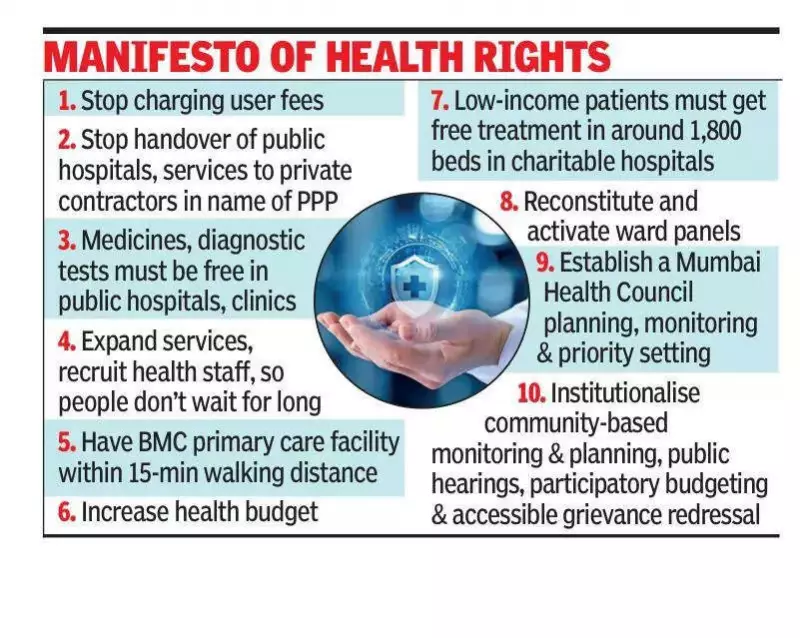
Ahead of the upcoming civic elections, a prominent coalition of health NGOs has issued a stark manifesto demanding a major overhaul of Mumbai's ailing public healthcare system. The Jan Swasthya Abhiyan (JSA) has called on the Brihanmumbai Municipal Corporation (BMC) to dramatically increase funding, halt privatisation efforts, and urgently recruit staff to address critical weaknesses.
Core Demands of the Health Manifesto
The manifesto, developed through extensive discussions, presents a clear roadmap. Its central demand is for the BMC to raise its health expenditure to 25% of its total budget over the next five years. This is seen as essential to reverse years of underinvestment. The coalition also demands an immediate end to the civic body's push for Public-Private Partnerships (PPPs), which it calls 'Civic Health Collaborations'.
Dr. Abhay Shukla of JSA stated that the manifesto will be sent to various candidates and political parties for endorsement. The group has previously led protests against such PPP models. Notably, the BMC had floated tenders for PPPs at the 581-bed Shatabdi Hospital in Govandi and a 400-bed facility in Lallubhai Compound, Mankhurd. A similar plan for Bhagwati Hospital in Borivli was scrapped after intervention by Union Minister Piyush Goyal.

Rebuilding a System for People, Not Profit
The JSA argues that privatisation and chronic underfunding have severely weakened Mumbai's public health services. The manifesto urges politicians to focus on ways to "rebuild public healthcare for people, not profit". A key recommendation is for the BMC to restart ward committees to ensure direct public oversight and management.
To reduce the financial burden on citizens, the manifesto calls for scrapping the user fee system introduced in the 1990s. The goal should be to guarantee free medicines, diagnostics, and procedures at all public hospitals. "Efforts should be made to reduce out-of-pocket expenditure for citizens," emphasized Dr. Shukla.
Expanding Access and Regulating the Private Sector
The plan also includes significant expansion of community-based care. It highlights the need to increase the number of 'aapla davakhana' clinics, which operate within local communities during evenings. Health economist and JSA member Dr. Ravi Duggal pointed out that given Mumbai's population, the city needs at least 700 such clinics. The coalition advocates for one primary healthcare centre for every 20,000 people, located within a 15-minute walking distance.
To strengthen the system's human resources, the JSA demands that all vacancies across BMC health facilities be filled through regular recruitment






