

Nagpur Residents Confront Health Crisis from Burst Sewer Line in Godhani Society
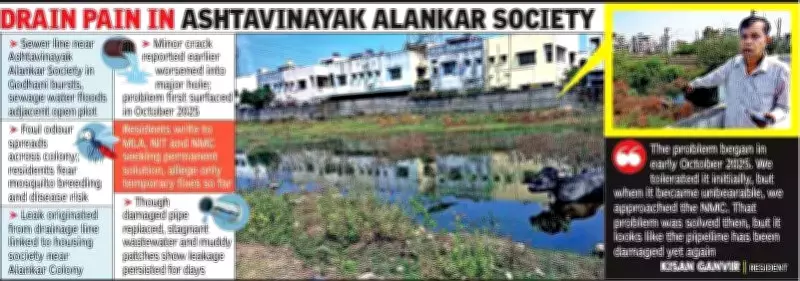
Residents of Ashtavinayak Alankar Society in Godhani, Nagpur, are grappling with a severe public health emergency as a burst sewer line near their residential complex continues to emit foul odours and create hazardous conditions. The situation has escalated into a major concern for the local community, with fears mounting over potential disease outbreaks.
Sewage Accumulation Creates Unbearable Conditions
The sewer line, which originates from another housing society near Alankar Colony, developed multiple leakages that have resulted in sewage water accumulating on vacant land adjacent to an ongoing construction site. This has created an unbearable stench that permeates the entire area, making daily life difficult for residents.
The stagnant wastewater has turned the open plot into a potential breeding ground for mosquitoes, posing serious health risks to vulnerable populations including children, elderly citizens, and women. The damp, foul-smelling soil indicates that the problem has persisted for an extended period despite temporary fixes.

History of Neglect and Temporary Solutions
This is not the first time residents have faced this issue. A similar problem had surfaced earlier and was only resolved after residents approached their local MLA. With the problem resurfacing, the society association has once again written to multiple authorities including:
- The local MLA
- Nagpur Improvement Trust (NIT)
- Nagpur Municipal Corporation (NMC)
Residents are demanding immediate intervention and a permanent solution to what they describe as a recurring nightmare.
On-Ground Reality: Persistent Problems Despite Repairs
When journalists visited the site, they observed sewage water spread across the open plot, with clear evidence that the problem had persisted for several days. Although the damaged pipe had been removed and a new line installed, traces of stagnant wastewater and muddy patches remained visible.
The surrounding area showed signs of recent digging, with loose soil and debris scattered around, suggesting that repair work had been attempted but failed to address the root cause of the problem.
Resident Testimonies Highlight Systemic Failures
Kisan Ganvir, a school van driver and resident, revealed that a minor leak had existed for a long time before worsening significantly. "The problem began in early October 2025. We tolerated it initially, but when it became unbearable, we approached the NMC. That problem was solved then, but it looks like the pipeline has been damaged yet again," he explained.
In official letters to civic authorities, residents have documented how drainage lines passing behind the colony frequently overflow, leaving the area consistently dirty and unhygienic. Despite repeated complaints, they claim only temporary inspections and empty assurances have been offered.
No permanent corrective action, fund allocation, or work orders have been issued to address what residents describe as a fundamental right to live in a hygienic environment.
Authorities Remain Unresponsive
Despite multiple attempts to contact officials from the NMC's Mangalwari zone, no responses have been received, leaving residents frustrated and concerned about their health and wellbeing. The lack of official engagement has exacerbated tensions in the community, with residents questioning the effectiveness of local governance structures.
The situation in Godhani serves as a stark reminder of the challenges facing urban infrastructure in rapidly developing areas, where temporary fixes often replace comprehensive solutions, leaving residents to bear the consequences of systemic neglect.






