

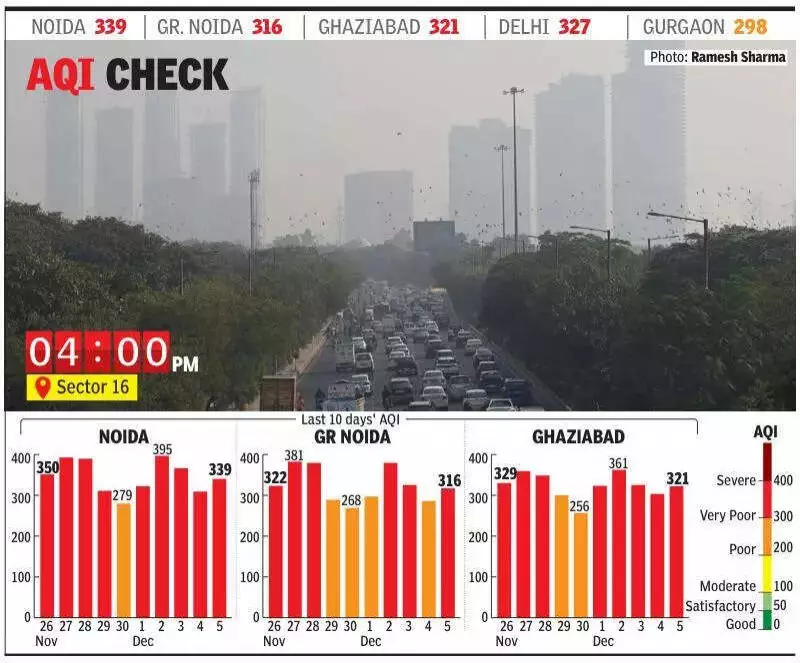
The air quality across the National Capital Region (NCR) took a significant turn for the worse on Friday, with monitoring stations in Noida, Greater Noida, and Ghaziabad all recording a dip into the 'very poor' category. This marks a concerning escalation in pollution levels as winter conditions tighten their grip on the region.
Sharp Decline in Air Quality Index
Data from the Central Pollution Control Board revealed a clear downward trend. Noida's overall AQI shot up to 339 from 308 recorded on Thursday. Neighbouring Ghaziabad was not far behind, registering an AQI of 312, compared to 302 the previous day. In Greater Noida, the air quality slipped back into the 'very poor' category with a reading of 316, after being in the 'poor' range (285) a day earlier. Delhi mirrored this trend, with its AQI standing at 327 at 4 PM, up from 304.
Station-Wise Breakdown Reveals Localised Hotspots
A closer look at data from individual monitoring stations painted a granular picture of the pollution crisis:

- In Noida, Sector 125 was the worst affected with an AQI of 373, followed by Sector 116 at 350. Sector 62 recorded a slightly better, but still 'poor', AQI of 296.
- In Greater Noida, Knowledge Park V recorded 'very poor' air (AQI 345), while Knowledge Park III was in the 'poor' category (AQI 286).
- In Ghaziabad, Sanjay Nagar (AQI 331) and Indirapuram (AQI 311) both suffered 'very poor' air quality.
The stark contrast from last year was evident. On the same day in 2023, Noida, Greater Noida, and Ghaziabad had recorded much healthier AQIs of 116, 142, and 104 respectively, all in the 'moderate' category.
Administration Springs into Action on Pollution and Cold
Facing the twin challenges of deteriorating air and a biting cold wave, the district administration convened a high-level meeting. Deputy Collector Charul Yadav stated that officials from various departments discussed a detailed action plan for public safety and relief. Key directives included urgent road repairs, pothole filling, and installing safety signage at construction sites.
The traffic department was instructed to affix reflective tapes on vehicles, promote safe driving distances, and run awareness campaigns. A critical order was issued to ensure that no person is left sleeping on the roads during the cold nights. Urban local bodies were told to distribute blankets and ensure all night shelters provide round-the-clock amenities like drinking water, toilets, and bedding.
Enforcement Drives and Meteorological Factors
On the pollution front, the Noida Authority remained active. On Friday alone, 14 enforcement teams fined 10 violators a total of Rs 14.9 lakh for flouting Graded Response Action Plan (GRAP) norms. To curb dust, around 60 sprinklers sprayed treated sewage water over 260 km of roads, and 14 mechanical sweepers cleaned 340 km.
The Indian Institute of Tropical Meteorology attributed the pollution buildup to local meteorological conditions. Surface winds on Friday came from the northwest at speeds up to 15 kmph during the afternoon, but slowed to 10 kmph by evening, allowing pollutants to accumulate. The forecast for Saturday predicted westerly winds with speeds potentially reaching 22 kmph in the afternoon, which may offer slight dispersion, before dropping again at night.
The day's weather saw a minimum temperature of 5.6 degrees Celsius and a maximum of 23.5 degrees, underscoring the cold wave conditions that the administration is preparing to tackle in the coming days.






