

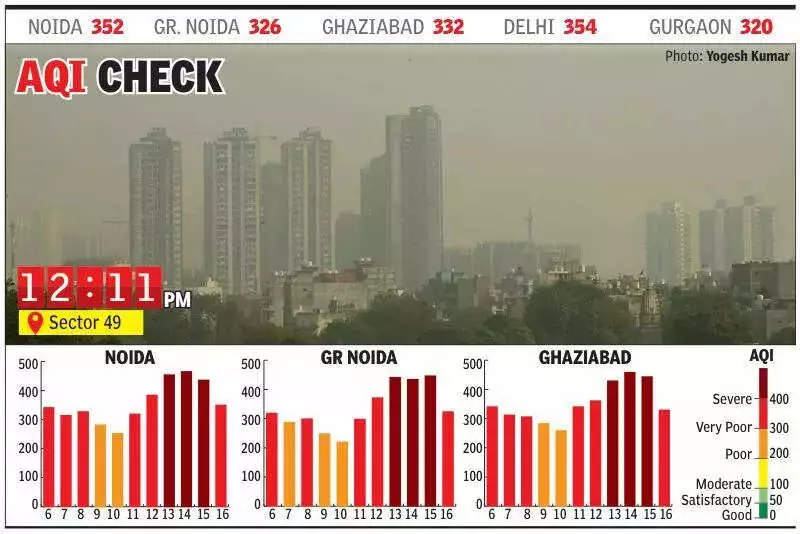
Residents of Noida and Ghaziabad breathed a cautious sigh of relief on Tuesday as increased wind speeds led to a noticeable improvement in the region's toxic air quality. After enduring three consecutive days of 'severe' and 'severe plus' pollution levels, the Air Quality Index (AQI) finally dropped into the 'very poor' category across most monitoring stations.
AQI Numbers Show Significant Drop
The data from the Central Pollution Control Board (CPCB) painted a clear picture of improvement. In Noida, the AQI settled at 352, a significant drop from Monday's alarming 437. The neighbouring Greater Noida also saw its AQI improve to 326 from 447. Ghaziabad mirrored this positive trend, with its AQI reading falling to 332 from 444 recorded just a day prior.
All four air monitoring stations in Noida recorded 'very poor' air quality. Among them, Sector 1 reported the highest pollution level with an AQI of 380. It was followed by Sector 125 (AQI 367), Sector 116 (AQI 336), and Sector 62 (AQI 314). In Greater Noida, Knowledge Park V (AQI 341) and Knowledge Park III (AQI 312) also remained in the 'very poor' bracket.

The situation in Ghaziabad showed a slight variation. Three of its four stations recorded 'very poor' air, with Vasundhara being the worst at 382. Loni recorded an AQI of 333, and Sanjay Nagar stood at 322. Indirapuram, however, was the only area to slip into the 'poor' category with a comparatively lower AQI of 293.
Meteorological Factors Behind the Improvement
The primary reason for this welcome change was a shift in weather patterns. According to the Indian Institute of Tropical Meteorology, the predominant surface wind on Tuesday came from the northwest direction. These winds reached speeds of up to 20 kilometres per hour during the afternoon, helping to disperse the accumulated pollutants. The wind speed, however, decreased to around 8 kmph during the evening and night.
The forecast for Wednesday predicted shallow fog in the morning. The wind direction is likely to shift to the west, with speeds reaching up to 15 kmph in the morning and afternoon. Experts anticipate the wind speed to drop below 10 kmph again in the evening and night, which could lead to pollutant accumulation once more.
Administration Enforces Strict GRAP Measures
In response to the persistent pollution crisis, Noida's Chief Executive Officer, Lokesh M, convened a crucial review meeting on Tuesday. The meeting focused on the strict implementation of the Graded Response Action Plan (GRAP). Officials from various departments, the district administration, and representatives from schools, colleges, and IT firms attended the session.
The CEO directed IT companies, schools, and academic institutions to adopt online or hybrid modes of operation. This measure, specifically for GRAP Stages III and IV, aims to promote work-from-home policies to drastically reduce the number of vehicles on the road. "This will help in checking pollution," the CEO stated.
Further directives included a ban on organising large events to prevent vehicular congestion. Officials were also instructed to ensure strict compliance with pollution norms by all factories operating in the city. "The team will also keep a watch on the burning of waste and act against violators," Lokesh M added. An emphasis was also placed on increasing roadside greenery as a long-term mitigation measure.
While the improved wind speed has provided temporary respite, the administration's active measures highlight the ongoing battle against air pollution in the National Capital Region. Residents remain hopeful for sustained cleaner air as authorities ramp up enforcement actions.






