

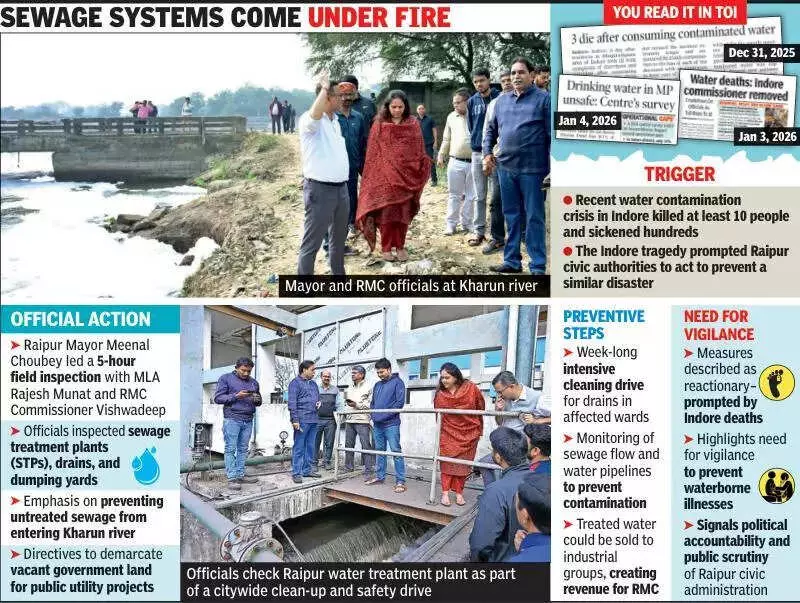
The tragic water contamination crisis in Indore, which has resulted in at least ten fatalities and hundreds falling ill, has triggered urgent safety measures in neighboring Raipur. The incident, caused by sewage reportedly entering the drinking water supply, has raised alarms across central India about the vulnerability of urban water infrastructure.
Raipur's Proactive Inspection Drive
In a direct response to the Indore disaster, Raipur Mayor Meenal Choubey, accompanied by former Cabinet minister and Raipur West MLA Rajesh Munat and RMC Commissioner Vishwadeep, conducted an extensive five-hour field inspection on Sunday. The team's objective was clear: to assess critical public welfare projects and prevent a similar tragedy in the state capital.
The inspection covered multiple key sites. At the Sarona dumping yard, officials noted that approximately 80% of the waste had been cleared using poklane machines. MLA Rajesh Munat directed the concerned officials and contractor to complete the remaining work at the earliest.

The team also visited government land near the Sarona Shitla Mata temple. The Mayor and MLA instructed authorities to immediately demarcate these vacant plots and submit a formal plan to the state government for developing public utility projects on them.
Focus on Sewage Treatment and River Protection
A crucial part of the inspection was the visit to the 75 MLD Chandanidih Sewerage Treatment Plant (STP) and its SCADA control room. Here, officials were instructed to develop a concrete plan to stop untreated sewage from flowing into the Kharun river. The team also inspected the Chingri and Pihar drains to understand the flow of wastewater.
MLA Rajesh Munat outlined a dual-purpose vision for the treated sewage. "The objective is to ensure all sewage water reaches the STP for treatment. This treated raw water can then be sold to industrial groups, creating a permanent source of revenue for the Raipur Municipal Corporation," he explained, highlighting a sustainable model for waste management.
Door-to-Door Checks and Pipeline Safety
Simultaneously, the RMC water department sprang into action in the Maharishi Valmiki Ward. After repairing a leakage near Vijay Nagar Chowk, the department initiated a supply of clean, chlorinated drinking water to several residential areas. Teams from the water works department and Zonal Offices 3 and 9 conducted door-to-door inspections on Sunday morning.
These teams checked chlorine levels in households across Sales Tax Colony, Mahamaya Vihar, Pink City, Gayatri Nagar, and Vijay Nagar. Following Mayor Choubey's instructions, they confirmed that all households were receiving clean water with adequate chlorine content, and no complaints of contamination were reported during the drive.
In a significant move to prevent future contamination, zonal health officers of Zones 3 and 9 were directed to launch a week-long intensive cleaning drive for all drains in the ward. Staff were tasked with removing silt and waste to ensure the smooth flow of sewage.
Officials were given a critical additional task: to identify and report any water pipelines found running inside drains during the cleaning process. The water department aims to relocate these pipelines outside the drains on a priority basis to eliminate a major contamination risk.
A Call for Vigilance and Cooperation
The Raipur Municipal Corporation has emphasized the need for constant vigilance to prevent water-borne illnesses, explicitly citing the recent health concerns in Indore. Officials have been instructed to maintain strict monitoring of the entire water distribution network.
The RMC water department has also appealed to the residents of Maharishi Valmiki Ward to cooperate with field staff from Zones 3 and 9. This cooperation is vital for identifying and shifting the water pipelines that currently pass through drains, a dangerous practice that compromises water safety.
This series of inspections and directives marks a belated but crucial reactionary move by Raipur's civic authorities. The shadow of the Indore crisis has made the urgent need for robust water and sewage management undeniably clear, prompting action aimed at safeguarding public health in the state capital.






