In an extraordinary act of conservation, a stone quarry in Telangana has suspended all its operations and written off a significant sum of money to ensure the safe hatching of five eggs belonging to a rare and endangered bird. The incident, which unfolded at the Yenakathala quarry in Vikarabad near Hyderabad, highlights a remarkable commitment to wildlife protection over commercial gain.
A Chance Discovery Saves a Nest
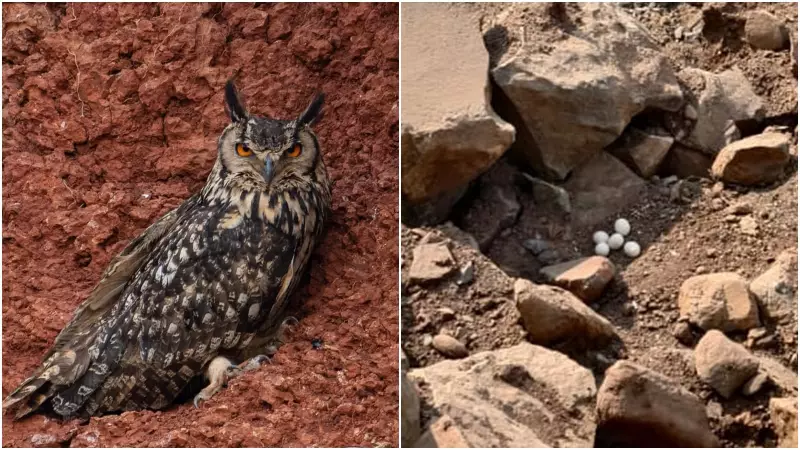
The chain of events began with a fortunate sighting by two photography enthusiasts. Manoj Kumar Vittapu, joint secretary of the Telangana Photographic Society, and his friend Shreeniwas Kandukuree were on a photography trip through the quarry in early December 2025 when they stumbled upon a sight few ever see. They spotted a rock eagle owl (Bubo bengalensis), a master of camouflage, perched on the edge of its nest, which was cleverly hidden in a nook of the stone cliffs.
The situation was perilous. The long arm of a JCB machine was hanging precariously over the nest site. "One more swipe, and the nest would have disappeared," Vittapu later recounted. Understanding the urgency, the photographers immediately rushed to the quarry manager, Prashanth Reddy, to plead for the bird's protection.

Immediate Action and Significant Sacrifice
The quarry management responded with surprising speed. They were informed that the rock eagle owl is a Schedule I animal under India's Wildlife Protection Act, placing it on the endangered list and affording it the highest level of protection, equivalent to that of a tiger. Work at the site was swiftly put on standby.
However, the decision came with a heavy financial cost. With operations halted, the quarry is incurring a daily loss of approximately Rs 1.2 lakh. Over the estimated 30-day incubation period, the total loss is projected to be around Rs 35-40 lakh. The quarry owner, Laxma Reddy, who held all necessary permits for mining on the revenue land, initially needed more convincing given the scale of the financial hit.
To reinforce the request, Vittapu and Kandukuree reached out to Principal Chief Conservator of Forests C Suvarna, who personally intervened. Following this, Vikarabad District Forest Officer G Gnaneshwar dispatched two forest officials to the site to ensure compliance and protection.
Creating a Sanctuary for a Miracle
The forest department explained that the owl had meticulously chosen its nesting site. The long grassy patch adjacent to the rock crevice provided perfect camouflage for the brown and grey bird, which is native to India's hilly scrub forests. Given the bird's sensitivity, experts ruled out relocating the nest, as human touch would likely cause the owl to abandon its eggs, and the precarious location risked cracking them.
Therefore, a multi-pronged protection strategy was implemented. Not only was quarrying halted, but visitor access to the area was also strictly restricted. "No one, including photographers, is allowed because we want the owl to have a peaceful incubation space. Till the eggs hatch and the hatchlings fly away, we will restrict entry of visitors and quarry machines," stated DFO Gnaneshwar.
The eggs, estimated to be about two weeks old at the time of discovery in early December, have an incubation period of six to eight weeks. The entire community is now waiting for the "miracle" hatchlings to emerge. For Prashanth Reddy, the quarry manager, the sentiment is clear: "It’s good that we stopped. We wanted to protect that bird." For photographer Manoj Vittapu, who has seen many owls but never a nest, playing a role in saving five of these rare birds is an unforgettable achievement, a true conservation victory born from a chance encounter.