

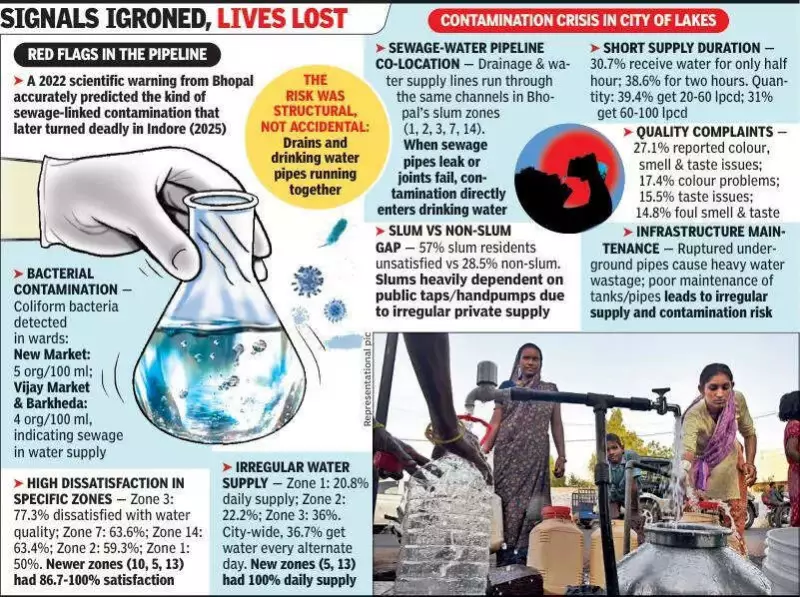
A stark scientific warning issued for Bhopal in 2022 manifested tragically in a lethal 2025 contamination incident in neighbouring Indore, highlighting how swiftly infrastructure failures can escalate into public health disasters. The earlier study had pinpointed a critical flaw in Madhya Pradesh's capital: drainage and drinking water pipelines often share the same underground channels, creating a direct route for sewage to poison the water supply whenever pipes crack or joints fail.
The 2022 Study: A Clear and Present Danger
Conducted by researchers Archana Sen, Namita Sen, and Vineesha Singh from Barkatullah University, the study was based on a survey of 400 households across 14 of the city's then 19 municipal zones. It concluded that the co-location of drains and water lines was a recipe for contamination and potential disease outbreaks, particularly in densely populated slum areas.
The investigation revealed a city divided by infrastructure and income. Older neighbourhoods and peripheral zones dominated by slums faced the worst conditions. These areas suffer from frequent pipe ruptures, poor maintenance, and irregular water supply. This forces residents to rely on narrow service windows, public handpumps, and water tankers. Crucially, in these vulnerable localities, drainage and water infrastructure either share trenches or are laid perilously close together. This dramatically increases the risk that any leak from a sewer line will seep into the adjacent drinking water mains.

Inequality in Water Security
In stark contrast, the study found that better-planned, higher-income zones in newer parts of Bhopal reported more reliable daily supply and had better physical separation between water and sewage networks. This disparity underlines the unequal distribution of environmental risk within the same city, where the urban poor bear the brunt of systemic neglect.
An Unheeded Warning with Lethal Consequences
The core warning of the research was unequivocal: the existing layout of underground networks makes contamination structurally likely. The only solutions are a comprehensive redesign of these systems and rigorous, ongoing monitoring. Despite the city expanding its water infrastructure, this fundamental warning remains largely unaddressed.
The recent sewage-linked contamination incident in Indore, which resulted in a death toll, serves as a grim validation of the study's findings. It demonstrates that the risks identified in Bhopal are not theoretical but pose an immediate and lethal threat to urban populations across the region when ignored.
The tragedy underscores an urgent need for civic authorities to audit and overhaul ageing and dangerously integrated water and sewage systems. Prioritising infrastructure upgrades in the most vulnerable areas is not just a matter of equity but a critical step in preventing future outbreaks and saving lives.






