

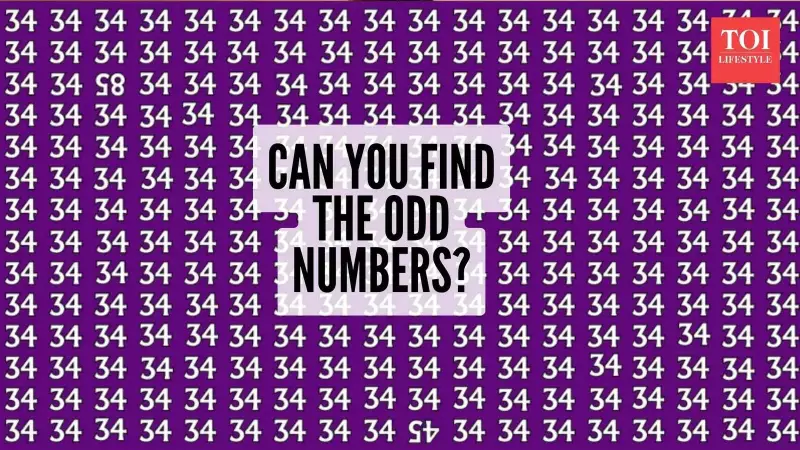
Do you believe your eyesight is flawless and your attention to detail is sharp? A deceptively simple optical illusion is taking the internet by storm, promising to reveal the truth about your visual perception in just 17 seconds. The challenge appears straightforward but has left many stumped on their first attempt.
The 17-Second Visual Challenge Explained
The task is set before you: a grid densely packed with the number 34, repeated over and over. Your mission is to find the two interlopers hiding in plain sight – the numbers 45 and 85. The catch? They are inverted, and you have a mere 17 seconds to locate both. The ticking clock adds a layer of pressure that makes this brain teaser trickier than it initially seems.
Why Your Brain Struggles With This Illusion
This puzzle exploits a fundamental feature of how our brains process information. Our minds are wired to recognize patterns efficiently. When confronted with a sea of identical '34's, the brain quickly categorizes the entire grid as uniform to save cognitive energy. This automatic pattern recognition, while helpful in daily life, causes us to overlook minor discrepancies.

The inverted numbers 45 and 85 are cunningly designed to blend in. Their font, size, and spacing are nearly identical to the surrounding 34s. The subtle differences in their shapes – the curves of the '5' and '8' versus the '3' and '4' – are easy for a pattern-seeking brain to dismiss. Your eyes may scan the image, but your brain, operating on autopilot, can skip right over the anomalies.
Pro Strategies to Crack the Puzzle
If you want to beat the clock, a random scan is your enemy. Adopt a systematic approach instead. Break the grid into smaller, manageable sections. Methodically examine each row or column individually, forcing your brain to process each element rather than the whole pattern.
Focus intently on the shape and form of each digit, not just its perceived value. Pay close attention to the angles and curves. The number 3 has a distinct top and bottom curve, while 4 is angular, 5 has a unique belly, and 8 is formed by two loops. Training your eye to spot these minute variations is key to success. Remember, the 17-second limit is part of the test, designed to induce a rush that can hinder careful observation.
What Your Performance Reveals About You
Successfully spotting the hidden numbers within the time limit indicates strong visual acuity and exceptional attention to detail. Individuals who excel at such puzzles often perform well in professions that demand high focus, like editing, graphic design, coding, or analytical problem-solving.
However, failing to find them does not mean you have poor eyesight. It primarily shows that your brain's efficient, but sometimes overzealous, pattern-recognition system took over. The good news is that observation skills can be honed with practice. Trying the puzzle again without the timer often feels significantly easier, proving that mindful practice can improve your performance.
Optical illusions like this are more than just entertaining diversions. They are fascinating windows into how our brains interpret visual information, especially under pressure. Regularly engaging with such challenges can help sharpen your observational skills and make you more aware of your cognitive blind spots. So, did you find the 45 and 85?






