

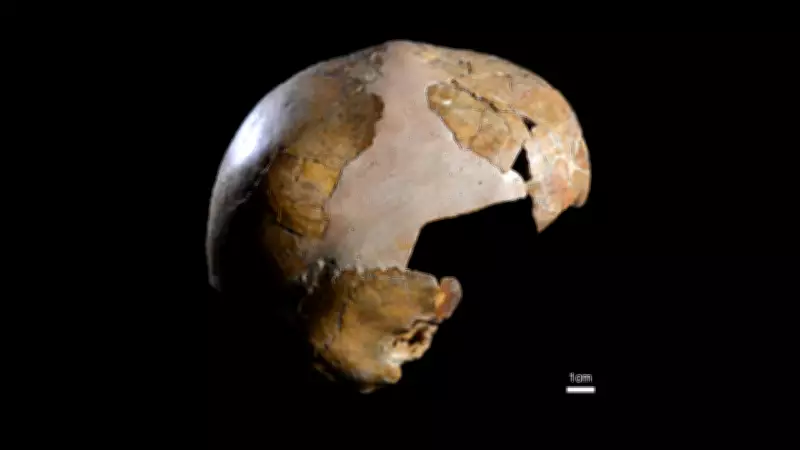
Ancient Skull Debunked: Not a Human-Neanderthal Hybrid, DNA Reveals
For years, a 7,500-year-old skull discovered in Eastern Europe captivated scientists and the public alike, sparking theories that it might represent a rare hybrid between Homo sapiens and Neanderthals. The enigmatic facial features, blending characteristics of both species, fueled speculation due to the known historical interbreeding between these groups. However, recent advancements in genetic technology have unraveled this mystery, providing a clearer picture of human ancestry.
Re-examining the "Human-Neanderthal Hybrid" Claim
Initial morphological analysis of the skull revealed a mix of features, with some traits resembling Homo sapiens and others akin to Neanderthals. This led researchers to hypothesize a hybrid origin, especially given that most modern humans carry traces of Neanderthal DNA from ancient admixture events. Studies, such as the paper 'A new analysis of the neurocranium and mandible of the Skhūl I child: Taxonomic conclusions and cultural implications,' highlighted greater diversity in early human skeletal remains than previously assumed, suggesting that what was once deemed archaic might simply reflect normal variation within Homo sapiens populations.
DNA Analysis Reveals a Different Story
The turning point came with the ability to conduct genetic analysis on the specimen. Scientists isolated DNA from the remains and employed cutting-edge technology to assess ancestry accurately. The results were definitive: this individual showed no unique traces of Neanderthal heritage beyond the common levels found in early modern humans. Research in human genomics, as noted in Nature Communications, underscores that genetic data offer a more robust framework for studying ancient admixture than morphological evidence alone, confirming the skull belongs to an early Homo sapiens, not a hybrid.

Why Was There Skepticism Around the Skull?
Firstly, differentiating between inherited traits and evolutionary adaptations poses challenges in paleoanthropology. Early humans exhibited mosaic appearances due to extensive migrations and environmental changes, making such variations unsurprising.
Secondly, while genetic connections between Neanderthals and modern humans are well-documented, morphological similarities do not necessarily indicate hybridization. These overlaps can arise from shared ancestry or convergent evolution.
Finally, this case exemplifies the iterative nature of scientific discovery. It serves as a reminder to avoid exaggerations and base conclusions on comprehensive evidence, ensuring accuracy in reconstructing human history.
Overall, the skull's journey from a potential hybrid to a confirmed early modern human illustrates how scientific exploration evolves with technology. Though the conclusion is quieter, it advances our understanding of human evolution, emphasizing the complexity of our origins and the importance of genetic insights in unraveling ancient mysteries.






