

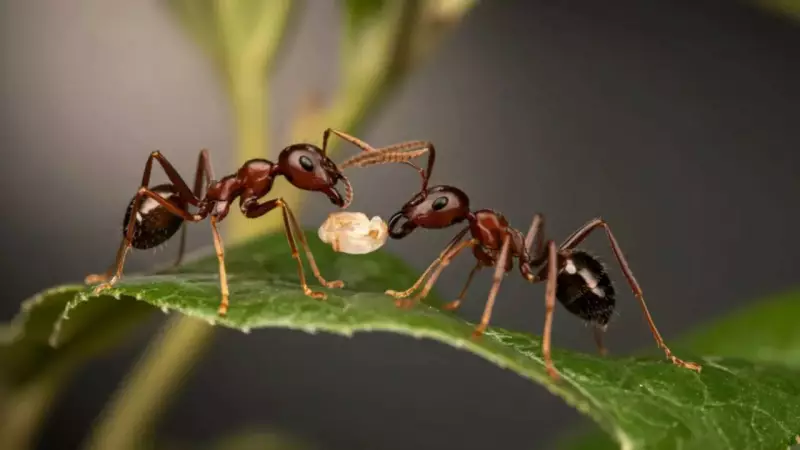
In a startling revelation from the insect world, scientists have documented a profound act of self-sacrifice. Baby ants, when infected by a deadly fungus, deliberately send out a chemical signal asking their colony mates to kill them. This extreme measure prevents the disease from spreading and wiping out their entire community.
The Desperate Chemical Plea of a Dying Pupae
The research, focused on the ant species Lasius neglectus, found that young ants in the pupal stage are sealed inside a protective cocoon. This makes them tragically vulnerable. If infected by the lethal fungus Metarhizium brunneum, they cannot move away to isolate themselves. Instead, they have evolved a chillingly effective solution.
These infected pupae release a specific, altered body odour that acts as a clear alarm signal. It is a deliberate chemical message, essentially a plea saying, "I am a threat, eliminate me." The study, titled "Altruistic disease signalling in ant colonies" and published in the prestigious journal Nature Communications, proves this scent is purposeful and not a random byproduct of illness.

Researchers confirmed this by applying the scent from infected pupae onto healthy ones. Immediately, worker ants responded to the chemical cue. They tore open the cocoons of the perfectly healthy pupae and executed them, demonstrating that the scent alone is a powerful and sufficient trigger for the lethal response.
A Swift and Brutal Execution for the Greater Good
Once the "kill me" signal is detected, the worker ants act with swift efficiency. They extract the infected pupa from its cocoon, bite tiny holes into its body, and then spray it with formic acid. Ants naturally produce this acid as a potent antimicrobial agent.
The formic acid serves a dual purpose: it rapidly kills the invading fungal spores before they can multiply, and it also ends the life of the infected pupa within minutes. While this seems harsh from a human perspective, for the ant colony, it is a calculated trade-off. The survival of the collective superorganism is paramount, outweighing the life of a single individual. Sacrificing one pupa is a small price to pay to avert a catastrophic epidemic.
Colony as Superorganism and a Royal Exception
Scientists often describe ant colonies as superorganisms, where individual ants function like cells in a single large body. In this context, the worker ants killing an infected pupa is analogous to the human immune system destroying a diseased cell to protect the whole body. From an evolutionary standpoint, this behaviour is logical. Since worker ants are sterile, ensuring the survival of their closely related siblings (who share their genes) is how their genetic legacy continues.
However, the study uncovered a critical exception to this rule of sacrifice. Only worker pupae send the altruistic death signal. Future queen pupae, which possess stronger immune systems and are vastly more valuable to the colony's long-term survival, do not release the chemical plea. Losing a potential queen is too great a risk. This shows the system is precisely targeted and activated only when necessary, highlighting a sophisticated level of social immunity.
This discovery adds a dramatic new layer to our understanding of social immunity in animals. While ants were already known to groom each other and remove corpses to prevent disease, the act of infected young voluntarily calling for their own death is one of the most extreme examples of cooperative defence ever recorded in nature. It is a powerful reminder that in the natural world, loyalty and sacrifice can take forms that are both beautifully coordinated and brutally pragmatic.






