

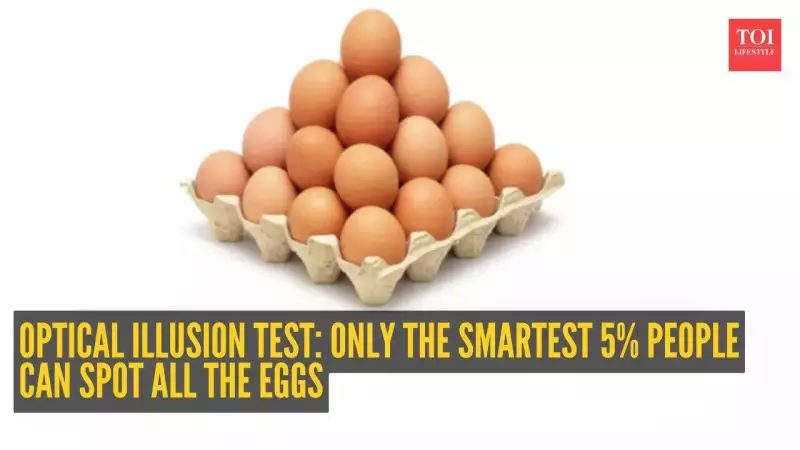
Are you ready to test the sharpness of your mind and vision? A fascinating optical illusion, based on a simple image of an egg tray, is taking the internet by storm. According to a report by The Sun, this particular visual puzzle is so tricky that only a mere 5% of people manage to solve it correctly. If you believe you possess a top-tier intellect, this is your moment to prove it.
The 10-Second Brain Challenge
Here is how the challenge works. You have just 10 seconds to look at the image of the egg tray and determine exactly how many eggs are on it. It sounds straightforward, but there is a major catch. This is not a simple 2D picture; it is a cleverly constructed 3D image designed to deceive your perception. Your brain and eyes must work in perfect harmony, and speed is absolutely crucial.
Optical illusions are far more than just entertaining diversions. They serve as excellent mental exercises that reveal how our brains process visual information, often "filling in" gaps based on assumptions. Regularly solving these puzzles is known to enhance problem-solving skills, focus, and spatial reasoning. Experts suggest that the ability to crack such illusions quickly is a strong indicator of high intelligence and superior cognitive function.

Breaking Down the Egg Tray Illusion
So, what is the correct answer? Most people who attempt this test quickly guess a number between 16 and 20 eggs. This, however, is the common and incorrect answer. The key lies in visualizing the structure in three dimensions, from the bottom layer upwards. Many viewers completely miss the middle layer of eggs.
Let us do the precise calculation:
- Layer 1 (The Solid Bottom Base): This layer has a grid of 4 eggs by 4 eggs, totaling 16 eggs.
- Layer 2 (The Middle Row): Sitting on top of the bottom layer is a second tier arranged in a 3 by 3 grid, which adds 9 more eggs.
- Layer 3 (The Top Layer): The final layer consists of a 2 by 2 grid (4 eggs) plus one single egg placed in the center, contributing 5 eggs.
When you add them all up: 16 + 9 + 5 = 30 eggs in total! Did your mental model account for all the hidden layers, or did you fall into the 2D trap?
The Psychology Behind the 5% Success Rate
Why do so few people see all 30 eggs? The answer lies in our brain's visual processing. The human visual cortex is wired to prioritize recognizable patterns and surfaces. Individuals who think in a more two-dimensional, literal way see only the immediately visible eggs.
In contrast, people with higher spatial reasoning abilities automatically construct a three-dimensional model in their mind's eye. This allows them to intuitively account for the hidden structural layers. This skill is closely linked to fast pattern recognition and excellent working memory.
It is no surprise that professionals who regularly manipulate 3D spaces—such as engineers, architects, and surgeons—often excel at these tests. The average brain, however, tends to accept "what you see is what you get," missing the complexity beneath the surface.
How many eggs did you manage to spot? Whether you saw 16, 20, or the full 30, engaging with such puzzles is a fantastic workout for your cognitive muscles. Share your result and challenge your friends to see if they belong to the elite 5%!






