

The Milgram Experiment: Unraveling Obedience to Authority
In the early 1960s, a profound and unsettling question emerged within the confines of a Yale University laboratory: to what extent would an average individual comply with commands from an authority figure, even if it meant causing harm to another person? This inquiry, spearheaded by psychologist Stanley Milgram, would evolve into one of the most referenced and debated studies in contemporary psychology.
Historical Context and Motivations
Milgram's obedience experiments, conducted from 1961 to 1962, were not born out of mere academic curiosity. They were deeply influenced by the horrific aftermath of the Holocaust and, more specifically, the trial of Adolf Eichmann. Eichmann, a key architect in the Nazi regime's systematic mass murder of Jews, infamously defended his actions by asserting he was "just following orders." In his 1974 book, Obedience to Authority, Milgram posed a direct challenge: "Could it be that Eichmann and his million accomplices in the Holocaust were just following orders? Could we call them all accomplices?" This set the stage for a groundbreaking investigation into human behavior under pressure.
Experimental Design and Methodology
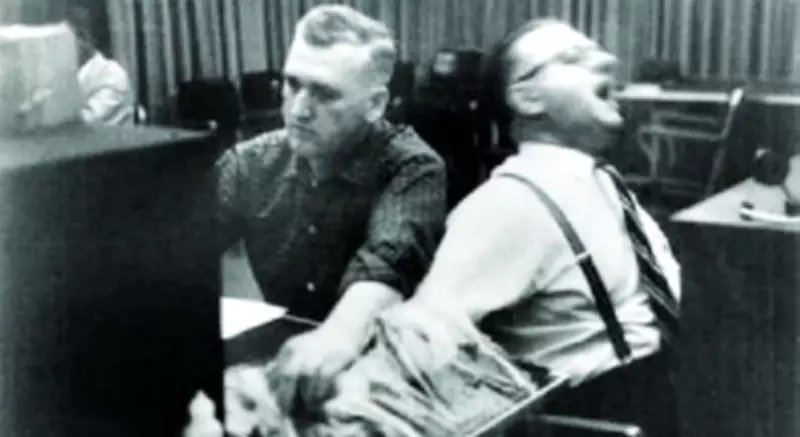
Milgram recruited participants via newspaper ads, framing the study as research on learning and memory. In the most renowned version, 40 men were paid $4.50 each to take part. They were assigned the role of "teacher," while an actor, posing as another participant, played the "learner." The learner was placed in a separate room and connected to a device that appeared to deliver electric shocks.

The teacher operated a shock generator with labels ranging from 15 volts to 450 volts, increasing in 15-volt increments. The switches were marked with escalating warnings: "slight shock," "moderate shock," "danger: severe shock," and finally, "XXX." The task involved reading word pairs and administering a shock for each incorrect answer, with the voltage rising progressively.
Unknown to the participants, the shocks were not real. The learner's responses were scripted: starting with mild discomfort, escalating to complaints about a heart condition, demands for release, and at 300 volts, pounding on the wall before falling silent. When participants hesitated, the experimenter issued standardized prompts:
- "Please continue."
- "The experiment requires that you continue."
- "It is absolutely essential that you continue."
- "You have no other choice; you must go on."
Key Findings and Interpretations
In this primary version, the results were startling: 65% of participants (26 out of 40) proceeded to the maximum 450-volt level. Many exhibited visible distress, including protests, nervous laughter, and questions about the procedure, yet they continued under instruction. Milgram concluded that individuals are highly susceptible to authority, often overriding personal morals in specific situational contexts.
He identified several factors that bolstered compliance:
- The physical presence of the authority figure.
- The credibility associated with Yale University.
- The gradual escalation of voltage, making each step seem minor.
- A tendency for participants to shift responsibility onto the experimenter.
When these conditions altered—such as when the authority was absent or peers refused to comply—obedience rates dropped significantly. For instance, in one variation, 36 out of 40 participants stopped early.
Later Research and Complexities
Subsequent studies have nuanced Milgram's findings, suggesting that obedience is not solely about authority but also involves identification with the authority figure's goals and legitimacy. Variables like proximity to the victim and the presence of dissenting peers further shape behavior, indicating that obedience is context-dependent rather than automatic.

Ethical Concerns and Criticisms
From the outset, the experiments sparked intense ethical debates. Participants were deceived about inflicting real harm, leading to significant psychological distress, including anxiety and guilt. The coercive prompts, especially "You have no other choice; you must go on," have been criticized for undermining the right to withdraw.
While Milgram claimed participants were debriefed, later investigations, such as those by psychologist Gina Perry, challenge this. In her book, Behind the Shock Machine: The Untold Story of the Notorious Milgram Psychology Experiments, Perry argues that the reality involved more coercion than pure obedience, with inadequate debriefing for many participants.
Questions of Validity and Replication
Critics note that the 65% obedience rate is from one specific variation; other versions showed lower rates, sometimes with no participants reaching the maximum shock. Evidence suggests some participants doubted the setup, with those believing the shocks were real less likely to continue. Modern replications, constrained by ethical standards, yield mixed results, limiting direct comparability to the original study.
Enduring Legacy and Relevance
Despite its controversies, the Milgram experiment remains a cornerstone in psychology education. It is celebrated not only for its insights into obedience but also for highlighting the limitations of experimental design. Its simple yet powerful setup continues to provoke discussions on authority, moral responsibility, and ethical research practices.
As Gina Perry reflects, the study has evolved into a "powerful parable" that resonates decades later, serving as a narrative that challenges our understanding of human nature and societal norms.





