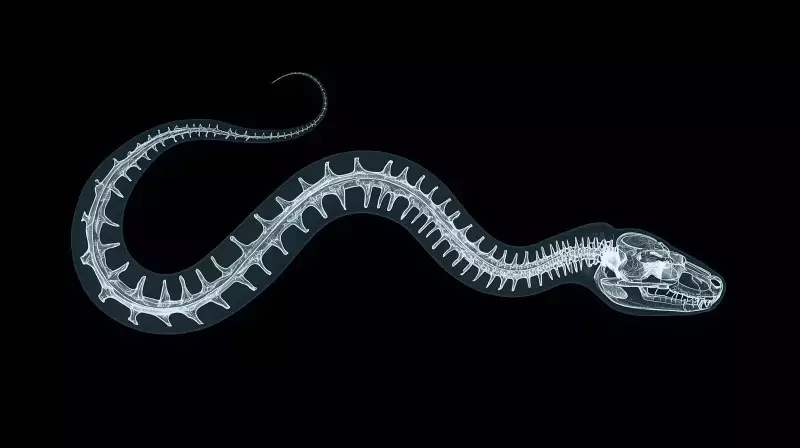
Have you ever paused at a scientific paper title not because it was complex, but because it seemed fundamentally odd? The phrase 'right-handed snakes' has exactly that effect. Snakes don't write or throw, so how can they be right-handed? A fascinating 2007 study provides the answer, revealing a remarkable story of evolutionary adaptation driven by a simple prey: the snail.
The Discovery of Asymmetry in Snake Skulls
The research, titled 'Right-handed snakes: convergent evolution of asymmetry for functional specialisation' and available on PubMed Central, focused on Iwasaki's snail-eater. When scientists examined the snake's skull under X-ray, they found a clear, though subtle, imbalance. The right side of the jaw consistently had more teeth than the left side. This wasn't a random defect but a functional adaptation. These snakes don't crush shells; they meticulously extract the soft body from the opening. More teeth on one side provide superior grip and control, turning the jaw into a specialized tool perfectly fitted to a specific task.
This asymmetry is a classic case of evolution in action. There was no grand plan. The snakes that happened to have a slight advantage in extracting snails survived and reproduced better. Over countless generations, this repeated use and advantage solidified into a permanent structural change written into bone. The snake's form literally followed its function.

Why Right-Handed? The Snail Connection
The reason for this right-handed bias lies in the prey itself. The vast majority of snail species coil their shells to the right. This 'right-handed' coiling is simply how their bodies grow. For a predator, the common right-coiled shell becomes the standard template to which it adapts. The angle of attack, the resistance points, and the extraction path are all learned and optimized for this predominant shape.
Researchers tested this by observing four snakes feeding on both right-coiled and the rare left-coiled snails. The results were stark. Right-coiled snails were consumed efficiently and quickly. Left-coiled snails, however, caused significant trouble. The snakes hesitated, their perfected technique faltered, and some snails even managed to escape entirely, surviving in the lab for a week after the attack. The predator was not incompetent; it was simply a specialist tuned to a different shape.
The Survival Edge of Being Different
This evolutionary arms race has a fascinating twist. The very rarity that makes left-coiled snails unusual also grants them a survival advantage against predators shaped by the majority. The study suggests these snails escaped more often from the right-handed snakes. Separate research found similar benefits, with left-coiled snails surviving crab attacks more frequently. Being different can confuse a predator's expectations.
However, nature is full of trade-offs. While being left-coiled might aid survival, it can hinder reproduction, as famously seen with Jeremy, the left-coiled snail who struggled to find a compatible mate. Evolution doesn't seek perfect, harmonious solutions. It leaves these tensions unresolved, allowing them to play out quietly in the background, driving diversity and specialization.
This story of right-handed snakes and right-coiled snails is a powerful reminder of how intimately connected predator and prey can become. It shows how a simple, repeated interaction—a snake eating a snail—can, over deep time, sculpt anatomy and write a rule of specialization directly into an animal's skeleton.