

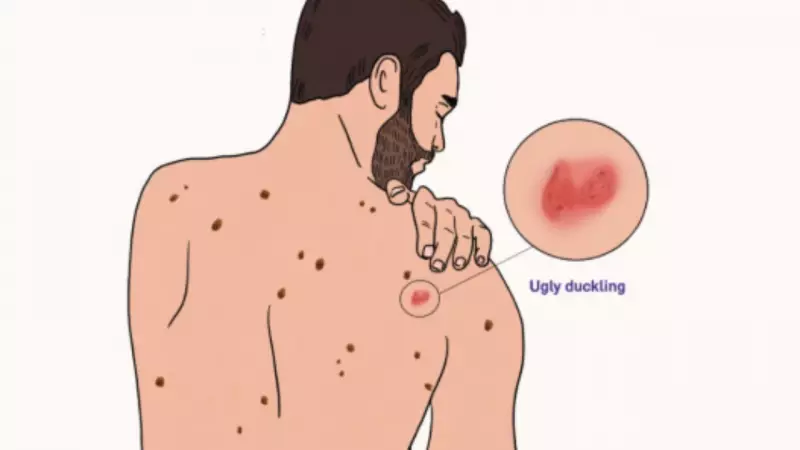
Have you ever looked at your skin and noticed one mole that just doesn't fit in with the rest? Dermatologists call this the "ugly duckling" sign, a powerful and simple visual clue that can be the first hint of a potentially deadly melanoma. This method relies on pattern recognition rather than complex rules, making it a crucial tool for early detection.
The Science Behind the Ugly Duckling Sign
The concept was formally introduced by researchers Jean-Jacques Grob and Remy Bonerandi in their 1998 study. It focuses on identifying the one lesion that stands out from its neighbours in terms of size, shape, colour, or texture. While most moles on an individual's body share a family resemblance—similar shades of brown, smooth borders, and a diameter typically under 6mm—the ugly duckling breaks this harmony. It might be significantly larger (over a centimetre), a different colour, have a bumpy texture among flat moles, or even bleed and crust.
This approach is particularly effective for people with many moles, where a slightly irregular one might be missed by standard ABCDE rules alone. The ugly duckling, however, screams mismatch against the crowd. The original research, published in the Archives of Dermatology, emphasised comparing lesions within a person's unique skin pattern, a trick benign spots rarely fool.

Robust Research Validates the Method
Multiple studies have confirmed the effectiveness of this simple check. In a 2008 study published in JAMA Dermatology, led by Alon Scope, Stephen W. Dusza, and Allan C. Halpern, researchers examined back photographs of 12 high-risk patients, five of whom had confirmed melanomas. Among 34 observers of varying expertise, every melanoma was identified as the ugly duckling by over two-thirds of participants. Meanwhile, only 2.1% of 140 benign moles raised false alarms, showing high sensitivity (90-100%).
A stronger validation came in 2017 from Caroline Gaudy-Marqueste, Jean-Jacques Grob, and colleagues in the Journal of the American Academy of Dermatology. Reviewing over 2,000 clinical and 766 dermoscopic images from 80 patients, nine dermatologists identified all melanomas as ugly ducklings. The method boosted specificity to 96% for clinical views and cut unnecessary biopsies nearly sevenfold when used with standard exams.
Further supporting evidence came from a 2015 NIH-backed paper by Thomas et al., which combined the ugly duckling sign with the ABCDE rule, achieving 88% sensitivity in detecting early melanomas among atypical moles. This body of evidence is why guidelines from organisations like the Skin Cancer Foundation now promote it.
Why Early Detection Is a Lifesaver
Melanoma is dangerous because it can spread rapidly if left untreated. However, stage 1 detection boasts a 99% five-year survival rate. The ugly duckling sign democratises vigilance. According to Scope's data, primary care doctors can spot these suspicious moles with 85% accuracy, drastically reducing unnecessary referrals for benign spots.
High-risk individuals—such as those with fair skin, a history of sun damage, many moles, or a family history of skin cancer—benefit immensely. The method personalises risk assessment without needing specialised equipment. Today, even mobile apps train users on this technique, mimicking study protocols for monthly self-examinations.
Practical Steps for Skin Safety
Building a simple habit can guard your health. Follow these steps monthly:
- Conduct a self-exam in good light, using mirrors or a partner's help to check your entire body, including your back, legs, arms, and scalp.
- Take smartphone photos in grids to track changes over time.
- Note your mole patterns and bookmark any "ugly duckling" with the date.
- If you see a mole that changes in weeks, book a dermatologist appointment immediately.
Complement this with sun-safe practices: slather on SPF 30+ daily, seek shade between 10 am and 4 pm, and wear protective clothing. Avoid tanning beds, which double the risk of melanoma.

Pair the ugly duckling strategy with the ABCDE rule: check for Asymmetry, irregular Borders, varied Colour, Diameter larger than a pencil eraser, and Evolution. Together, they harness the crowd wisdom your own skin provides. Research shows patients who self-detect using this sign often present with thinner, more treatable cancers. As Scope's study proved, even untrained observers can learn to spot the warning sign—empowering everyone to take charge of their skin health.





