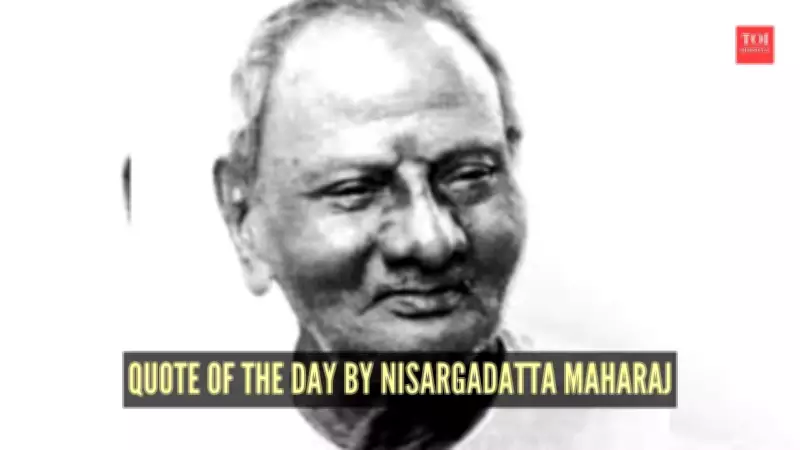
The Life and Legacy of Nisargadatta Maharaj
Nisargadatta Maharaj, born in 1897 and passing away in 1981, stands as one of the most revered spiritual masters of the 20th century. His profound influence stems from his unique approach to spirituality, which he lived out not in isolation but as an ordinary citizen. Unlike many spiritual figures who embraced renunciation, Maharaj operated a small shop, making his teachings deeply accessible and relatable to everyday life. This grounded existence allowed him to connect with people from all walks of life, bridging the gap between spiritual wisdom and practical reality.
The Path of Advaita Vedanta
Maharaj followed the path of Advaita Vedanta, a non-dual philosophy that emphasizes the fundamental oneness of all existence. This philosophy rejects the illusion of separation between the self and the universe, advocating for a direct realization of this unity. His teachings, which gained global recognition, were meticulously compiled in the seminal book "I Am That." This collection features dialogues with seekers from around the world, presented in a simple, unadulterated form that cuts through complexity to reveal core truths.
Core Teachings and the Essence of Self-Inquiry
At the heart of Nisargadatta Maharaj's message is the emphasis on self-inquiry and understanding one's real nature. He consistently highlighted the necessity of self-awareness and inner peace, arguing that spiritual striving often becomes a mental distraction. According to Maharaj, truth is not something to be acquired through effort but is already present within each individual, waiting to be recognized.

A Famous Quote and Its Deep Meaning
The quote, "There is nothing to practice. To know yourself, be yourself. To be yourself, stop imagining yourself to be this or that. Just be. Let your true nature emerge. Don’t disturb your mind with seeking" is widely attributed to Nisargadatta Maharaj and encapsulates the radical simplicity of his teachings. This statement reflects his direct and uncomplicated style, insisting that realization comes from understanding, not from accumulating practices or rituals.
What this quote conveys is a powerful critique of the common misconception that spirituality requires constant effort, discipline, or ritualistic actions. Maharaj suggests that the very search for spirituality can prevent its discovery. When he says, "There is nothing to practice," he is not dismissing spiritual practice entirely but pointing to a deeper reality: the self we seek is already here, requiring no improvement or change, only recognition.
Breaking Free from Mental Constructs
The instruction to stop imagining oneself as this or that addresses how we often define ourselves through external labels—such as occupation, status, personality, achievements, or failures. These mental constructs create a limited sense of self, obscuring our true nature. The command to "Just be" advocates for a state of awareness untouched by comparison or projection, allowing the true self, beyond ego and personal stories, to naturally reveal itself.
The line "Don’t disturb your mind with seeking" is particularly relevant in today's world, where personal development is often marketed as an endless journey. Maharaj implies that perpetual seeking keeps the mind agitated, whereas real understanding arises from observing experiences without disturbance. When the mind is calm, insight emerges naturally, without force or effort.
The Empowering Message of Simplicity
This quote by Nisargadatta Maharaj serves as a profound reminder that self-realization is not about becoming something new but recognizing what has always been present. It champions simplicity and calmness in a society obsessed with achievement and self-definition. Ultimately, Maharaj's message is empowering: truth is not distant, complicated, or reserved for a select few. It is here, within each of us, and all we need to do is be who we are—without distortion, effort, or relentless searching.

His teachings continue to inspire seekers worldwide, offering a path to inner peace through direct awareness and self-acceptance. By living as an ordinary shopkeeper while imparting extraordinary wisdom, Nisargadatta Maharaj demonstrated that spiritual enlightenment is accessible to everyone, regardless of their circumstances.