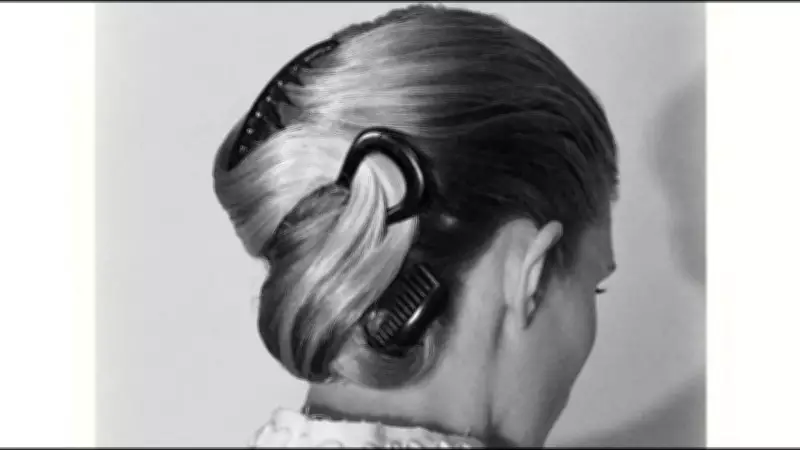
Long before claw clips and scrunchies dominated hair styling, the French comb was a staple accessory. Its origins trace back to ancient Greek and Roman times, where combs held twisted updos in place. In ancient Egypt, combs made of ivory and wood served not only for grooming but also as symbols of wealth and status. The French comb, as recognized today, has been around since the early 20th century, experiencing a brief but strong resurgence in the 1980s and early 1990s.
A Quiet Return to the Spotlight
Now, the French comb is making a quiet return. Its appearance at The Row's Spring/Summer 2026 show brought it back into focus. At a time when hair trends can feel loud and overdone, the French comb stands out for its simplicity, familiarity, and effortless elegance.
Editorial and celebrity hairstylist Guido Palau told Harper's Bazaar: "The combs could trigger a memory, maybe from a grandparent wearing hair combs in her hair or from a painting... There's something nostalgic, but it feels feminine, sculptural, and modern all at the same time and something people could try at home."

What Are French Comb Pins?
Also called French combs or French pins, these are curved, toothed hair accessories used to secure hair into a bun. They hold tresses in place by gripping gently but firmly against the scalp.
A Marker of Quiet Luxury
Luxury fashion stylist Meghna Ghodawat describes the French comb pin as belonging to a time when getting ready was slower and more intentional. "Women weren't chasing trends; they were refining what already worked. These pins held hair in place, but they also held a certain energy – composure, ease, and understated femininity. It wasn't about making a statement; it was about being yourself, but quietly."
Trending or Going Back to Basics?
Online, women are seen twisting their hair into sleek buns and securing them with a French pin – a look that has quietly gone viral. Playful iterations have emerged, too: pins shaped like bows or oversized safety pins. These are all extensions of the original French comb pin.
Meghna says, "It's more like a return to what we've always known, but perhaps forgotten in the noise. French pins come from a lineage of vintage hair rituals, where beauty was rooted in care and longevity. Today, as we begin to make mindful choices again, these pieces naturally find their way back into our lives."
Niti adds, "They make even simple outfits more curated and fashion-forward. As hair styling becomes a stronger focus in fashion and beauty, accessories like French pins provide an easy yet impactful way to elevate everyday looks."
According to Niti Gupta, "Vintage French comb pins are like mini tiaras – stylish, rich, and often embellished or ornate. They instantly create a formal appearance, making them perfect for occasions where a polished and sophisticated look is desired. A French pin, on the other hand, tucked into a loose bun, suggests ease and casual elegance."
Styling Tips
For everyday wear, twist hair into a loose bun or half-up style and let a few strands fall naturally around the face. Instead of tightly securing the hair, gently tuck the pin into the natural folds of the curls. For more definition, prep with a lightweight curl cream or leave-in, and finish with a hydrating serum for shine.
Celebrity hairdresser Isha Mahabal advises: "Those with thicker or more voluminous curls can section the hair before pinning to make styling more manageable and long-lasting. You can also stack two pins for added support without compromising on the minimal aesthetic."
Which Pins to Invest In
Gupta recommends versatile, neutral colours that work across outfits, a mix of vintage and modern designs, and one statement piece to lift simpler looks. Ghodawat suggests a classic faux tortoiseshell comb, a minimal French pin in brushed gold or matte metal, or something with a natural element — hand-carved wood or a crochet finish.
Beyond style, pins also represent a return to raw, soft sensuality. As Meghna Ghodawat puts it, "Classics aren't coming back; we're simply learning to choose them again, more consciously this time."