

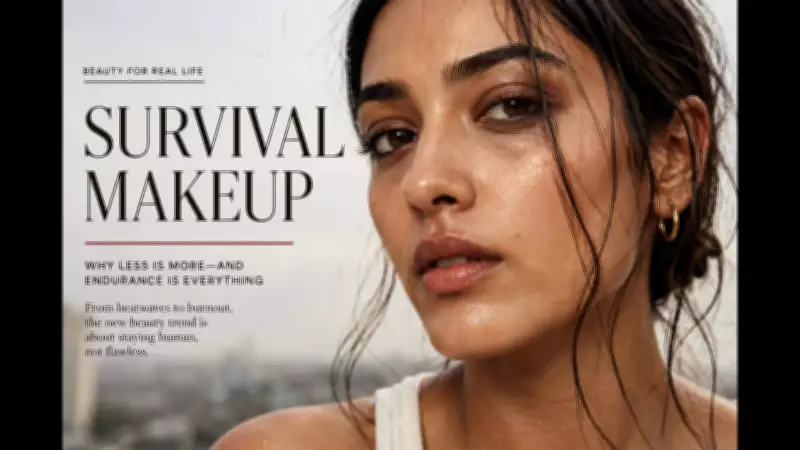
Survival make-up is the internet's latest beauty philosophy, born out of exhaustion, heat, economic anxiety, climate stress, and hyper-busy lives. Instead of elaborate contouring, 20-step skincare routines, or makeup designed mainly for photographs, survival makeup focuses on one question: What actually survives real life?
Think sweat-proof concealer, SPF sticks, lip-and-cheek tints, brow gels, under-eye correctors, and products that can stay intact through commutes, humidity, long workdays, emotional burnout, poor sleep, and extreme weather. It is less about transformation and more about endurance.
Survival Make-Up as a Social Mood
Survival make-up is less a beauty trend than a social mood. It emerged quietly online through phrases like tired girl makeup, burnout beauty, and commuter makeup, but the idea behind it is older and sharper: what kind of face can survive modern life?

Climate change, especially prolonged heat waves and humidity, has already altered how consumers buy cosmetics. Sweat-proof setting sprays, anti-pollution skincare, transfer-resistant formulas, and lightweight hybrid products are increasingly marketed not as luxuries, but necessities.
Not survive a red carpet or a selfie under perfect lighting. Survive heat, pollution, long workdays, burnout, poor sleep, rising temperatures, unstable economies, endless commuting, and the pressure of always being visible online.
The Aesthetic of Endurance
The aesthetic rejects the elaborate perfection that dominated the 2010s beauty era. Gone are the heavily sculpted contour lines, hour-long routines, and hyper-airbrushed Instagram face. Survival makeup is built around endurance and realism: skin tints instead of full-coverage foundation, under-eye correctors instead of complete concealment, cream blushes that melt into skin, waterproof mascara, SPF sticks, lip oils, brow gels, and products that can survive humidity and emotional exhaustion alike. The shift says something important about the culture producing it.
Beauty Burnout and Economic Anxiety
Beauty writer Jessica DeFino has written extensively about what she calls beauty burnout. In a widely discussed piece for Vogue Business, she describes contemporary beauty as an exercise in exhaustion. Her argument is not simply that routines have become too long, but that beauty itself has become tied to survival under unstable conditions — economic anxiety, climate change, digital hypervisibility, and job insecurity.
That observation is crucial because survival make-up is fundamentally about adaptation. Climate change, especially prolonged heat waves and humidity, has already altered how consumers buy cosmetics. Sweat-proof setting sprays, anti-pollution skincare, transfer-resistant formulas, and lightweight hybrid products are increasingly marketed not as luxuries, but necessities. In places such as Delhi/NCR or Mumbai, where summers are becoming harsher and commutes more punishing, heavy makeup can simply feel impractical.
The Psychological Shift
But the movement is psychological too. The internet's obsession with tired girl make-up revealed a growing fatigue with perfection culture itself. Articles in Vogue Arabia describe the trend as a rejection of hyper-polished beauty in favour of visible humanity — soft dark circles, smudged liner, flushed cheeks, lived-in skin.
The symbolism is deliberate. For years, beauty culture treated exhaustion as something to erase. Concealers promised to remove all evidence of stress, age, grief, or sleeplessness. Survival makeup does the opposite. It acknowledges that people are tired — and increasingly unwilling to pretend otherwise.
This is partly why younger audiences, especially Gen Z, have embraced the look. Unlike earlier beauty cultures that prized aspirational glamour, Gen Z aesthetics often favour emotional transparency and imperfection. The appeal of survival makeup lies in its realism. It does not promise transformation. It promises functionality.

Celebrity Endorsement of the Trend
Celebrities have accelerated the trend, though not always intentionally. Jenna Ortega is perhaps the clearest example. Her smudged eyeliner, muted skin, and deliberately fatigued gothic aesthetic — especially during the promotion of the TV show Wednesday — became shorthand for the tired girl look online.
Bella Hadid also embodies survival make-up's influence through minimalist, slightly undone beauty that prioritizes skin texture and realism over overt glamour. Meanwhile, Hailey Bieber helped normalize stripped-back, skincare-heavy beauty routines through the clean girl aesthetic, though survival makeup is arguably a darker, more emotionally honest evolution of that trend.
Even Pamela Anderson appearing makeup-free at fashion events became culturally significant because it signalled fatigue with relentless cosmetic performance. Her face looked less like a rebellion against makeup and more like exhaustion with compulsory perfection.
Online Communities and Beauty Burnout
Online discussions show this fatigue runs deeper than aesthetics. Reddit threads on beauty burnout are full of users describing makeup as emotionally draining, financially exhausting, and increasingly disconnected from real life. Many speak about abandoning complex routines after the pandemic, wanting lighter products, smaller collections, and faces that feel breathable in extreme weather and overstimulating environments.
Survival Make-Up as Resilience
What makes survival makeup culturally important is that it reframes beauty not as fantasy, but as resilience. It reflects a generation living through overlapping pressures — climate instability, digital overload, economic precarity, and chronic burnout — while still being expected to appear composed.
The face of survival makeup is not flawless. It is functional, adaptive, slightly tired, and still moving through the world.
About the Author
Haimanti Mukherjee: While not jumping with joy seeing every dog that comes her way (to the bewilderment of the dog owner and the dog), Haimanti fantasizes about fantasy books or classics to read and re-read. That could be the gist of it all, except for the aroma of biryani that beckons; or that idea that's stuck in the head and refuses to go till it's penned down.
