Groundbreaking Discovery in Saudi Arabia's AlUla Region
The Royal Commission for AlUla (RCU) in Saudi Arabia has announced a revolutionary archaeological find that fundamentally alters our understanding of early human history in the Arabian Peninsula. In the rugged landscapes of AlUla, researchers have uncovered compelling evidence of a sophisticated human settlement dating back an astonishing 13,500 years.
Organized Hunter-Gatherer Community Revealed
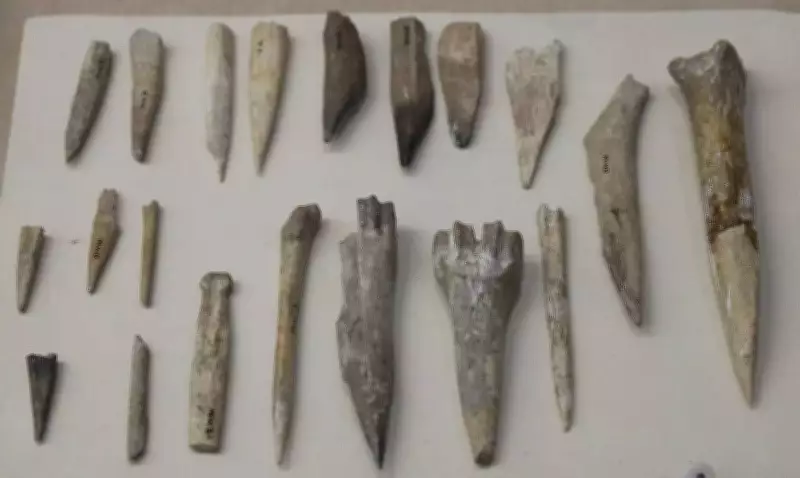
What has particularly astonished archaeologists is not merely the age of this site, but the remarkable level of organization it demonstrates. The discovery includes meticulously crafted stone tools, specifically bladelets associated with structured hunting practices. This indicates the location was not a temporary campsite but rather part of an evolving human system with established patterns.
The consistency observed in tool-making techniques, combined with the presence of multiple activity layers, strongly suggests a community that possessed deep environmental knowledge and successfully adapted to their surroundings over extended periods. Rather than representing scattered nomadic groups, these inhabitants appear to have formed an early version of desert society, demonstrating capabilities in planning, resource management, and potentially establishing seasonal settlement patterns.

Continuous Occupation Across Millennia
The site's timeline adds another dimension of significance to this discovery. While the earliest phase dates back approximately 13,500 years, evidence clearly shows that humans either continuously inhabited or periodically returned to the region for thousands of years afterward. A second major phase of occupation occurred between 10,300 and 8,700 years ago.
This continuity of habitation suggests that northern Arabia was not merely briefly inhabitable but consistently supported human life across changing climatic conditions. Over time, archaeologists observed an evolution in tool technology and an increase in artifact density, pointing toward growing populations and more stable settlement behaviors. This extended span of occupation strengthens the argument that Arabia played a sustained and crucial role in early human development.
Evidence of Extensive 190-Kilometer Trade Networks
One of the most compelling findings involves the discovery of obsidian and other materials that originated from sources located up to 190 kilometers away, likely from volcanic regions such as Khaybar. This indicates that early inhabitants either undertook extensive journeys or participated in primitive exchange networks.
Such long-distance movement challenges the traditional notion of isolated desert groups and instead paints a vivid picture of interconnected communities. In this context, the Arabian Peninsula emerges as a critical migration and interaction zone, effectively linking Africa, Asia, and the Levant. This discovery reinforces the theory that early humans did not avoid Arabia but actively moved through and settled within its diverse landscapes.
Connections to Ancient Natufian Culture
The tools discovered at the site show striking similarities to those associated with the Natufian culture, a prehistoric society renowned for pioneering early sedentary lifestyles in the Levant region. This connection suggests that northern Saudi Arabia was not culturally isolated but rather integrated into a broader prehistoric network.
The apparent exchange of techniques and styles implies significant interaction or shared knowledge across regions, highlighting Arabia's vital role in the larger narrative of human transition from nomadic hunting to more settled ways of life. It points toward the early formation of cultural identities that extended beyond geographical boundaries.
Rewriting the Archaeological Narrative of Saudi Arabia
This discovery is now compelling a major reconsideration of how archaeologists understand Saudi Arabia's history. For decades, much of the Arabian Peninsula was viewed as a marginal zone in early human history, largely bypassed due to its harsh climatic conditions. However, findings like this are dramatically transforming that narrative.

The evidence clearly demonstrates that Arabia was not an empty desert but a thriving and dynamic landscape that supported human life, innovation, and movement for thousands of years. This positions Saudi Arabia as a central piece in the complex puzzle of human evolution, rather than a peripheral one.
Global Significance of the Discovery
Beyond its regional importance, this archaeological site carries profound global implications. It reshapes established timelines of human migration, challenges fundamental assumptions about where early societies could exist, and highlights extraordinary human adaptability in extreme environments.
As experts continue to explore additional sites across northern Saudi Arabia, they anticipate that even older and more complex evidence could emerge. This discovery represents more than just a glimpse into the past—it is opening an entirely new chapter in our understanding of how humans spread across continents and built the foundational elements of civilization.