For most creatures on Earth, vision is a primary sense, crucial for navigation, finding food, and evading predators. However, in the perpetual darkness of underground caves, deep rivers, and subterranean waters, eyes serve little purpose. Remarkably, several animal species have not only adapted to these lightless realms but have evolved to thrive without sight altogether, relying on a suite of other heightened senses.
Nature's Masters of the Dark
In environments where sunlight never penetrates, the conventional need for eyes has faded over evolutionary time. These extraordinary animals have traded vision for super-powered alternatives like sensitivity to water movement, acute smell, vibration detection, and exquisite touch. Their existence challenges our understanding of survival, proving that life finds a way even in the most extreme conditions. Here are five such fascinating creatures that live and hunt successfully without eyes.
The Pale Dweller: Texas Blind Salamander
Found exclusively in the pitch-black water caves beneath Texas, the Texas blind salamander is a true creature of the deep. Its eyes are minuscule and covered by skin, rendering it completely blind. Adapted for a life without light, it has a pale white or light pink body and feathery red external gills for breathing underwater. With short legs and a long tail aiding its aquatic movement, this salamander typically measures between 3 and 5 inches in length, a ghostly figure navigating its dark world.

The Touch Specialist: Star-Nosed Mole
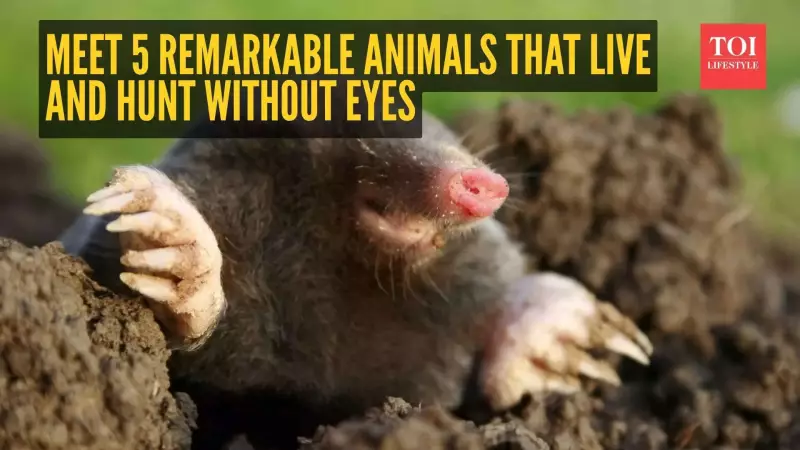
While not entirely blind, the star-nosed mole has eyes so tiny they are practically useless. Its namesake and superpower is the unique star-shaped nose, adorned with 11 pairs of pink, fleshy tentacles. This remarkable organ is packed with thousands of sensory receptors, creating one of the most sensitive touch systems known in the animal kingdom. It can identify and consume prey with astonishing speed. Incredibly, this mole can even smell underwater by exhaling air bubbles and re-inhaling them to capture scent molecules.
The Simple Yet Eternal: Freshwater Hydra
The freshwater hydra is a simple, tube-shaped predator that lacks not just eyes, but also a brain and true muscles. It anchors itself with a foot and uses a crown of stinging tentacles to capture food. To sense its environment, it relies on a decentralized network of nerve cells known as a nerve net. Adding to its marvel, the hydra possesses a high proportion of stem cells, allowing it to continuously renew its tissues, a trait that grants it a form of biological immortality and remarkable resilience.
The Subterranean Catfish: Widemouth Blindcat
Another eyeless resident of Texas's underground waters is the widemouth blindcat. This small, white or pink catfish has evolved a flattened, broad head and thick lips, perfect for scouring the bottom of dark aquatic caves for food. Its eyes are absent, and its gill openings are protected by membranes. Special sensory papillae on its head and body, particularly around its flat snout, help it detect minute changes in water pressure and movement, guiding it in the complete absence of light. It grows to about 5 inches long.
The Silent Hunter: Kaua'i Cave Wolf Spider
Endemic to the lava tubes of Hawaii's Kaua'i island, the Kaua'i cave wolf spider is a predator that hunts in utter darkness without the aid of eyes. It has completely lost its eyesight over generations of adaptation. To locate prey like small crustaceans, it depends on finely tuned senses that pick up vibrations and chemical cues in the air. Despite its small size—measuring only about half to three-quarters of an inch—it is an effective and agile hunter in its niche ecosystem.
These five animals demonstrate evolution's incredible power to adapt. Where light fails, other senses rise to the occasion, crafting masterpieces of survival in the world's hidden, dark corners. Their existence is a profound reminder of biodiversity's vast and often unseen scope.