Centuries before modern water management systems, India's master builders and architects created stunning subterranean structures that were far more than just water sources. These stepwells, known as baoli, vav, or pushkarni, stand as magnificent testaments to a civilization that seamlessly blended utility with breathtaking artistry, social space with spiritual sanctity, and engineering genius with aesthetic beauty.
More Than Just Wells: The Legacy of Stepwell Architecture
Designed to provide reliable water in arid regions and scorching summers, stepwells evolved into community hubs. They served as cool retreats, venues for social interaction, and sites for religious rituals. Their walls, often adorned with intricate carvings rivaling the finest temple sculptures, tell stories of gods, goddesses, and daily life, marking them as unique chapters in India's architectural history.
1. Chand Baori, Abhaneri: The Deepest Grandeur
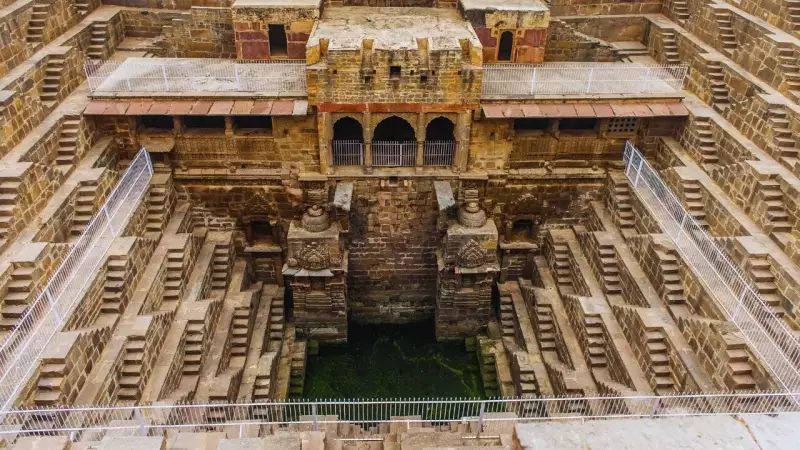
Located in Abhaneri, Rajasthan, Chand Baori is often hailed as one of the country's oldest and deepest stepwells. Historians believe it was constructed in the 9th century under King Chanda of the Nikumbh dynasty. This colossal structure is a geometric marvel, featuring 3,500 perfectly symmetrical steps descending 13 storeys to a depth of nearly 30 meters.

Built primarily for water conservation in Rajasthan's dry climate, it also functioned as a natural cooling system. The temperature at the bottom remains significantly lower than the surface, offering a vital refuge during peak summer heat.
2. Mata Bhavani’s Stepwell, Ahmedabad: An Early Prototype
Situated in Ahmedabad, Gujarat, this stepwell dates back to the Solanki period, likely the 11th century. Dedicated to Goddess Bhavani, it exemplifies the dual purpose of early stepwells: a vital water source and a sacred space. While its design is less ornate than later examples, its stepped descent is firmly rooted in ritualistic use, offering a clear window into the early evolution of stepwell architecture in western India.
3. Adalaj Stepwell, Gujarat: A Symphony in Stone
Just outside Ahmedabad lies the exquisitely carved Adalaj Stepwell (Vav). Built in 1499 by Queen Rudabai, this five-storey structure is renowned for its stunning fusion of Hindu and Islamic architectural styles, reflecting the era's changing political landscape.
Beyond its visual appeal, the stepwell incorporated an ingenious system that provided cool, filtered air and clean water, showcasing a deep understanding of climate-responsive design and hydraulic engineering.
4. Agrasen Ki Baoli, Delhi: An Urban Anomaly
In the heart of bustling New Delhi, Agrasen Ki Baoli presents a striking contrast. Believed to date from the medieval period and named after the legendary Maharaja Agrasen, this 60-meter-long stepwell is a mere 1.3 km from Connaught Place.
Its stark, elegant appearance, with three levels of arched niches, stands in silent dialogue with the modern skyline. Unlike most stepwells in rural settings, its urban location and associated tales of being haunted by spirits add to its unique, enigmatic charm.
5. Rani Ki Vav, Patan: The Crown Jewel
Topping the list is the magnificent Rani Ki Vav in Patan, Gujarat, a UNESCO World Heritage Site and a pinnacle of stepwell design. Constructed in the 11th century AD by Queen Udayamati in memory of King Bhima I of the Solanki dynasty, it is conceived as an inverted temple.
This seven-level masterpiece is adorned with over 1,500 exquisite sculptures, primarily devoted to Lord Vishnu and accompanied by apsaras and mythological figures. Buried under silt from the Saraswati River for centuries, its rediscovery in the 20th century revealed an exceptionally preserved monument of unparalleled artistic maturity.

Preserving a Subterranean Heritage
From the geometric precision of Chand Baori to the sculptural splendor of Rani Ki Vav, India's stepwells are more than historical relics. They are enduring symbols of community, resilience, and an ancient wisdom that harmonized human need with artistic expression and environmental adaptation. They remind us of a time when public infrastructure was built not just for function, but for the soul, leaving behind a beautiful, sunken piece of history for generations to marvel at.