

8 Modern Birds That Are Actually Living Dinosaurs: From Cassowary to Turkey
Have you ever watched a sparrow hopping in your garden and wondered if the mighty Tyrannosaurus rex might have moved in a similar way? The truth is more astonishing than fiction: birds are not merely related to dinosaurs—they are dinosaurs. They represent the last surviving lineage of these prehistoric creatures, having endured the catastrophic asteroid impact that wiped out their larger relatives 66 million years ago.
From flightless giants to aerial predators, these eight bird species exhibit unmistakable dinosaurian traits, including killer claws, wishbones, hollow bones, and distinctive struts. According to Professor Roger Benson, a dinosaur expert from Oxford University, "Birds share so many features with theropods... Walking on two legs, having feathers, they're just inherited features from dinosaurs." Today, history literally walks—and flies—right outside your window.
1. Hoatzin: The Punk-Rock Bird with Clawed Wings
Native to the Amazon, the hoatzin chick sports functional claws on its wing fingers—a direct throwback to Archaeopteryx and ancient maniraptorans, allowing it to climb trees adeptly. While adults lose these claws, they retain a reptilian odor from their unique leaf-fermenting digestive system, earning them the nickname "manure falcon." As confirmed by evolutionary biology studies from Berkeley, "The discovery that birds evolved from small carnivorous dinosaurs... was made possible by fossils from China." These unusual birds serve as a living bridge between Cretaceous climbers and modern avian oddities.

2. Cassowary: The Feathered Raptor of the Rainforest
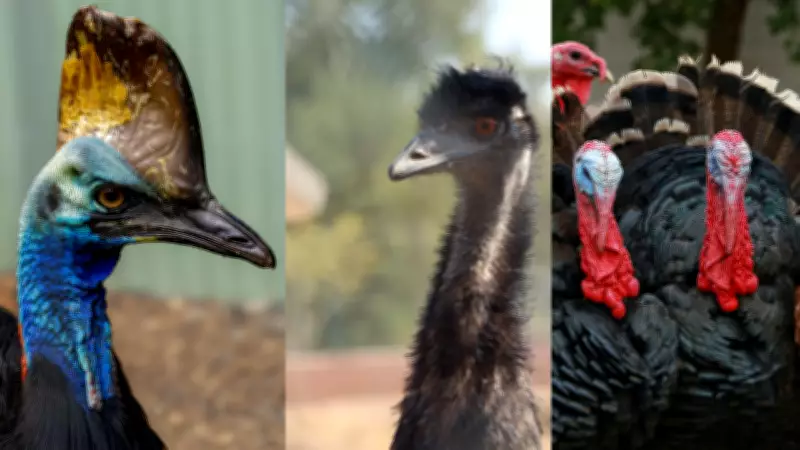
The southern cassowary, found in New Guinea's rainforests, is a formidable flightless bird equipped with switchblade-like toes that can slice through threats with precision reminiscent of a velociraptor. Capable of charging at speeds up to 50 km/h and wielding 12-centimeter daggers on its feet, this bird employs pure dinosaurian defense mechanisms. Its hollow bones and three-toed feet echo the anatomy of Cretaceous hunters. Professor Benson notes, "Birds inherit their bipedalism from theropods." Farmers rightly fear their aggression; one Australian man suffered a severe injury from a cassowary attack in 2019. Spotting one is like witnessing a feathered raptor brought back to life.
3. Emu: The Speedster with Dinosaur Legs
Australia's emu, the second-tallest living bird, mirrors its ostrich-like dinosaur ancestors with powerful legs built for sprinting at 60 km/h. Its tiny, vestigial wings and long neck recall the ornithomimus, often called the "ostrich dinosaur." Theropod heritage is evident in their brood patches and egg-laying behaviors. Palaeontologist Michael Benton from the University of Bristol explains, "Archaeopteryx seemed fully fledged... but birdlike features have an older origin." Emus are known to deliver powerful kicks that have hospitalized humans, proving that some dinosaurs traded flight for incredible running prowess.
4. Chicken: Your Backyard Theropod
The humble backyard chicken is a direct descendant of theropod dinosaurs, including the mighty T. rex. Key features such as fused clavicles (forming the wishbone), drumstick-shaped legs, and scaly skin trace back to its prehistoric ancestors. Fossil evidence reveals that T. rex chicks had fluffy down, while adults sported proto-feathers. Chickens even exhibit tail-wagging behaviors similar to miniature rexes. Evolutionary biology records state, "Chickens belong to the clade Aves... direct descendants of theropod dinosaurs." That familiar clucky strut is essentially a predator's pose, miniaturized over millions of years.
5. Ostrich: The Giant with Bone-Crushing Kicks
As the world's largest bird, the ostrich possesses two-toed feet and leg muscles capable of delivering 500-pound kicks—enough to intimidate even ancient Egyptians, reminiscent of the Deinocheirus. Hollow bones support its 2-meter frame, enabling sprints of up to 70 km/h. The Australian Museum emphasizes, "Birds are specialized theropod dinosaurs... relatives include T. rex and Velociraptor." Their plume feathers evolved directly from dinosaur fluff. Racing an ostrich across the Kalahari Desert offers a visceral experience of dinosaurian thunder.

6. Peregrine Falcon: The Sky's Ultimate Predator
The peregrine falcon, Earth's fastest creature, achieves dive speeds of 390 km/h to capture prey mid-air, mirroring the hunting tactics of Microraptor. Its bone-crushing beak and specialized nostrils for high-speed aerodynamics are clear indicators of its dromaeosaur lineage. Professor Benson asserts, "If birds aren’t dinosaurs, we have no idea what they are." The falcon's radar-guided stoop is a definitive trait of a dino-bird, showcasing how flight has refined a raptor's innate ferocity. These apex predators are a feathered roar against extinction.
7. Turkey: The Gobbling Descendant with Dino Displays
The wild turkey of North America features fleshy appendages like the snood and wattle, comparable to the crests of hadrosaurs. It flies in short bursts and roosts high in trees, behaviors akin to arboreal maniraptorans. Evolutionary studies highlight that warm-bloodedness originated in dinosaurs, and the turkey's fan-tailed display is essentially a "dino parade strut." This bird's gobbling and strutting are living remnants of prehistoric rituals.
8. Cassowary: A Second Look at the Cretaceous Hunter
Revisiting the southern cassowary underscores its role as a quintessential living dinosaur. With switchblade toes that slice like a velociraptor's, a charging speed of 50 km/h, and 12-centimeter defensive daggers, it embodies pure dinosaurian defense. Its hollow bones and three-toed feet are direct echoes of Cretaceous hunters. As Professor Benson reiterates, "Birds inherit their bipedalism from theropods." The cassowary's fearsome reputation among farmers and its documented attacks reinforce its status as a feathered raptor reboot.
Conclusion: A Legacy in Feathers
From the cassowary's lethal claws to the falcon's breathtaking dives, these eight birds are living testaments to the dinosaurs' enduring legacy. Evolution has perfected their forms over millennia, ensuring that the ancient bones beneath their feathers continue to walk, run, and fly among us. The next time you spot a bird, remember to tip your hat to the prehistoric giants it represents.





