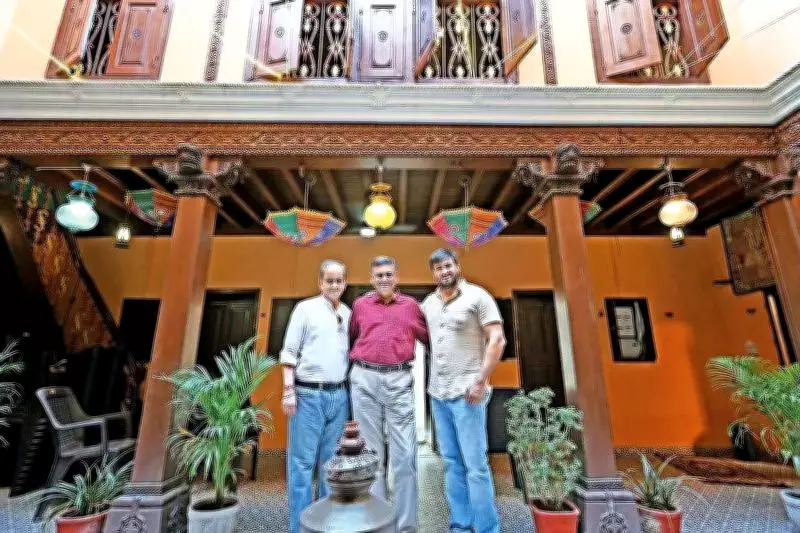
Ahmedabad's Engineering and Cultural Heritage Experiences Dual Revival
In a remarkable coincidence, Ahmedabad is witnessing the simultaneous restoration of two significant heritage landmarks connected by a common lineage. The iconic Ellis Bridge, a 19th-century engineering marvel, is being transformed into a pedestrian pathway by the city's civic body, while just a few streets away in the Walled City, the ancestral home of its original builder is being brought back to life after more than a century of neglect.
The Legendary Ellis Bridge and Its Defiant Creator
"London Bridge will fall before this one falls," declared Himmatlal Bhachech, the visionary engineer who designed and constructed Ellis Bridge in 1892. According to his great-great-grandson Vedas Engineer, the 480-meter bowstring arch truss bridge was completed for just Rs 4.07 lakh, nearly Rs 1 lakh below the sanctioned budget of Rs 5 lakh.
This remarkable cost efficiency raised suspicions among British authorities, who ordered a formal inquiry into the construction. The investigation ultimately proved that Bhachech's work was not only legitimate but actually of superior quality to what had been expected. This validation cemented the bridge's reputation and Bhachech's famous declaration about its durability compared to London Bridge.

A Transcontinental Journey to Preserve Family Heritage
Vedas Engineer, who spent 17 years living in the United States, has undertaken the ambitious restoration of his family's 250-year-old ancestral haveli located in Lakha Patel ni Pol. "I always wanted a home in a heritage precinct," explains Vedas. "This place reminds me who we are and where we come from."
To fund this passion project, Vedas made the significant decision to sell a property he owned in the French Quarter of New Orleans. However, the restoration journey began with formidable legal challenges rather than architectural ones. The haveli had been occupied by tenants for nearly a century, requiring Vedas's father, Rajiv Engineer, to wage extremely difficult court battles to secure vacant possession of the property.
"That legal battle was the toughest part of the entire process," Vedas acknowledges. "Only after winning it could we even think of restoring the house."
Traditional Restoration Techniques Revive Architectural Splendor
The structural condition of the haveli presented severe challenges upon acquisition. "The foundation had collapsed, there was water seepage and bat infestation," Vedas describes the initial state. The restoration team committed to authentic preservation methods, completely avoiding modern construction materials.
The entire haveli was restored without using even a pinch of cement, relying exclusively on traditional lime mortar as originally intended. Original wooden elements were carefully numbered, removed, and reinstalled, while Burmese teak was sourced to replace irreparable components. Due to the rarity of such specialized craftsmanship today, skilled artisans had to be brought in from Madhya Pradesh and Uttarakhand to execute the meticulous restoration work.
Historical Discoveries and Artistic Connections
During the restoration process, the family made an extraordinary discovery that further connected their ancestral home to Ellis Bridge. "We found original pencil blueprints of Ellis Bridge showing how my ancestor calculated the arches and load," Vedas reveals. "That was extraordinary."
Another highlight of the restored haveli is artwork created by a partially blind painter depicting Bhachech alongside his famous bridge. This same image later appeared in 'The London Times', introducing Ellis Bridge to British audiences and cementing its international recognition.
Together, these parallel restoration projects represent more than architectural preservation—they resurrect a crucial piece of Ahmedabad's engineering history and cultural identity, bridging centuries through meticulous craftsmanship and family dedication.