Major Ancient City Uncovered on Krishna River Bank in Telangana
In a significant archaeological revelation, historian Dr. Dyavanapalli Satyanarayana has reported the discovery of remains indicating a major ancient city on the left bank of the Krishna River in Dameracherla mandal of Nalgonda district, Telangana. The site presents compelling evidence of continuous human habitation spanning approximately 3,000 years, from around 1000 BCE to the 15th century CE.
Location and Historical Significance
Dr. Satyanarayana, who serves as curator of tribal museums for the Government of Telangana, identified the site along the southern boundary of Veerlapalem–Veerappagudem villages. The landscape reveals a remarkable chronological sequence, bearing traces from the Iron Age through the medieval period. The discovery includes:
- Hundreds of Iron Age megalithic burials (cairns) constructed with four upright stones capped by flat slabs
- Extensive fort walls and defensive bastions
- Ancient granaries, temples, wells, and residential structures
- Numerous sculptures and hero stones commemorating warriors
The presence of iron slag at multiple locations suggests early metallurgical activity, indicating local iron production capabilities sufficient for working large stone blocks. Dr. Satyanarayana, who has authored a book on Krishna River Valley Civilization in Telangana, emphasized that the perennial Krishna River provided essential water and natural resources that enabled this flourishing settlement to develop and sustain itself across millennia.

Threats to Megalithic Burials
The historian expressed grave concern about the rapid destruction of these archaeological treasures. The Iron Age burials, locally believed to be warrior graves (reflected in place names like Veerulapadu and Veerappagudem), face imminent threat from multiple sources:
- Extensive quarrying operations by a cement company
- Local quarrying activities by residents
- Destruction by treasure hunters seeking artifacts
Dr. Satyanarayana reported that many burials have suffered near disappearance due to these activities. The burial stones, locally known as Banjar Raallu (Palnadu stone), remain abundant in the area but require immediate protection.
Medieval Fortifications and Structures
While habitation evidence appears sparse for nearly a millennium following the megalithic phase, medieval remains from the 10th to 15th centuries are clearly visible at the site. Key features include:
- A square fortification measuring approximately 70 × 70 meters with a main southern entrance overlooking the Krishna River
- Foundations of internal structures and a southeastern bastion that likely served as a watchtower
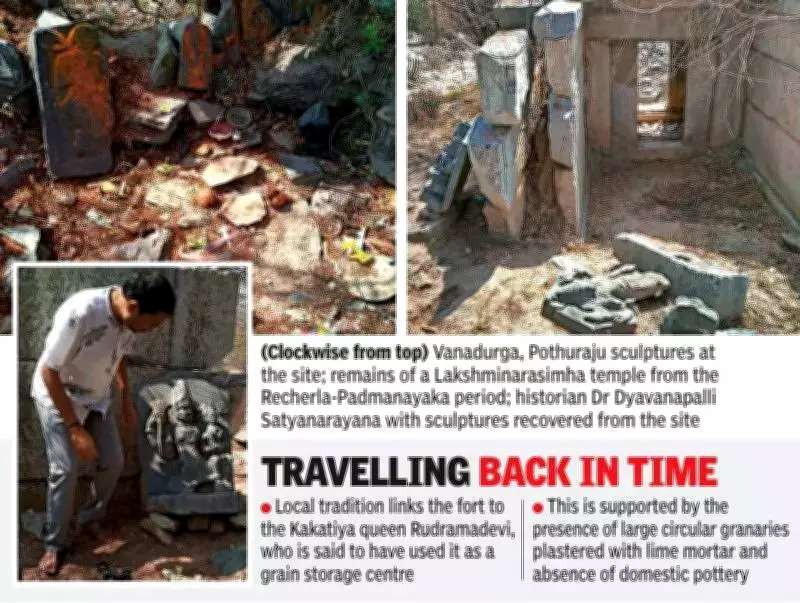
- Damaged shrines and sculptures depicting Vanadurga, Pochamma, Pothuraju, and Veerabhadra/Bhairava
- Several hero stones located to the northeast of the fort
Based on architectural analysis, Dr. Satyanarayana dates these remains to the period between the Kanduri Cholas and the Recherla Padmanayakas. Local tradition associates the fort with Kakatiya queen Rudramadevi, who reportedly used it as a grain storage center. This interpretation finds support in the presence of large circular granaries plastered with lime mortar and the notable absence of domestic pottery at the site.
Temple Discoveries and Artistic Heritage
Approximately one furlong south of the fort, on the riverbank, Dr. Satyanarayana identified a ruined Lakshmi Narasimha temple from the Recherla Padmanayaka period (14th–15th centuries CE). Although the front mandapa has been destroyed, parts of the sanctum survive. The historian personally recovered and reassembled broken idols of Lakshmi Narasimha, Adi Lakshmi, and Chenchu Lakshmi from the site.
Notable artistic elements include Garuda carvings on the pedestal and a nearby Dāsānjaneya sculpture, both indicating Padmanayaka patronage and contributing to our understanding of medieval artistic traditions in the region.

Urgent Call for Preservation
Citing rapid destruction due to ongoing quarrying and vandalism, Dr. Satyanarayana has issued an urgent appeal to the archaeology department to immediately document the site before what he describes as invaluable heritage disappears forever. The discovery represents not just a local historical treasure but a significant chapter in understanding the continuous human settlement patterns along the Krishna River Valley across three millennia of Indian history.
The comprehensive evidence—from Iron Age metallurgy to medieval temple architecture—positions this site as a crucial link in reconstructing the historical and cultural development of the Telangana region, making its preservation an archaeological priority of national importance.