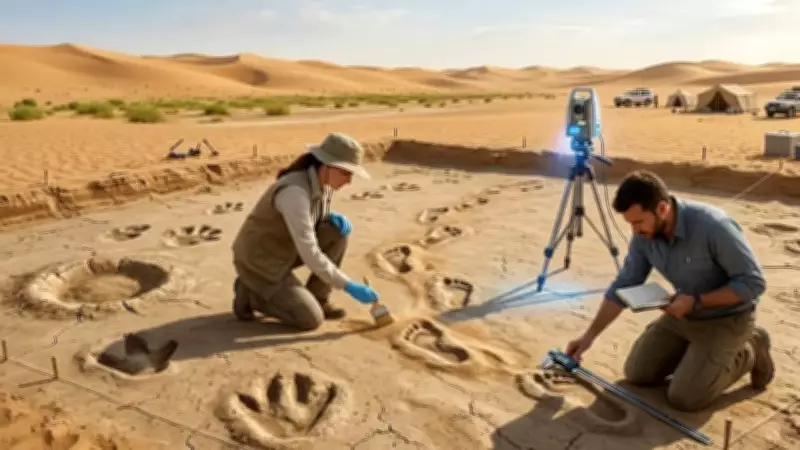
Groundbreaking Discovery of Ancient Human Footprints in Saudi Arabia
Archaeologists have made a monumental discovery in the heart of the Arabian Peninsula, unearthing 120,000-year-old human footprints at the ancient lake site of Alathar within Saudi Arabia's Nefud Desert. This remarkable find represents the oldest dated evidence of Homo sapiens presence on the Arabian Peninsula, fundamentally altering our understanding of early human migration patterns from Africa.
Scientific Collaboration Reveals Ancient Timeline
According to research published in the prestigious journal Science Advances, an international team of archaeologists from the Max Planck Institute and the Saudi Heritage Authority collaborated on this groundbreaking discovery. The researchers employed advanced optically stimulated luminescence (OSL) dating techniques to establish the precise 120,000-year chronology of these ancient footprints.
This discovery effectively fills a significant spatial and temporal gap in existing hominin dispersal models, providing the first concrete evidence for the presence of modern humans in this specific region during this ancient period. The Alathar site has yielded numerous well-preserved footprints that offer unprecedented insights into early human movement and settlement patterns.

The Green Arabia Phenomenon
During what scientists refer to as the Last Interglacial period approximately 120,000 years ago, the Nefud Desert was transformed into what researchers now call Green Arabia. This period was characterized by significantly wetter monsoon seasons that created large, permanent lakes and abundant grasslands where today only arid desert exists.
These dramatic environmental changes created ideal migration corridors that early humans and prehistoric megafauna could exploit. The inland lake systems served as excellent habitat areas and migration pathways, allowing both humans and animals to traverse regions that would later become inhospitable deserts.
Coexistence with Prehistoric Giants
The Alathar site reveals a fascinating picture of ancient coexistence. Alongside the human footprints, archaeologists have identified hundreds of tracks from various prehistoric species, including ancient elephants, horses, and giant camelids - all representing now-extinct Pleistocene megafauna.
Interestingly, the absence of stone tools at the site suggests that humans used the lake primarily as a temporary watering hole rather than a permanent settlement. This provides researchers with a unique opportunity to study how early humans moved through environments where they coexisted with enormous prehistoric animals.
Rewriting Human Migration History
This discovery challenges previous assumptions about the timing and routes of human migration out of Africa. According to the Saudi Ministry of Culture, the presence of modern humans in the Arabian interior approximately 120,000 years ago indicates that Homo sapiens expanded out of Africa earlier and more frequently than previously believed.
The research demonstrates that our ancestors not only traveled along coastal routes but also successfully navigated inland regions when environmental conditions permitted. The availability of sufficient water and food resources in Green Arabia created windows of opportunity for human migration that lasted for approximately 15,000 years during favorable climatic periods.
This extraordinary discovery at Alathar continues to provide valuable insights into how early humans adapted to changing environments and interacted with the prehistoric world around them, offering a more complete picture of our species' remarkable journey across continents.