Ancient Qur'anic Manuscript Emerges in Saudi Arabia After Nearly a Millennium
A remarkable manuscript, written approximately a thousand years ago, has been discovered in Saudi Arabia, providing an exceptionally detailed window into the foundational era of Qur'anic scholarship. This extraordinary find not only underscores the profound depth of classical Islamic academic traditions but also refocuses scholarly attention on an extensive archive of rare texts that have been meticulously preserved for rigorous academic investigation and research.
Unveiling of "Gharib Al-Qur'an" and Its Historical Significance
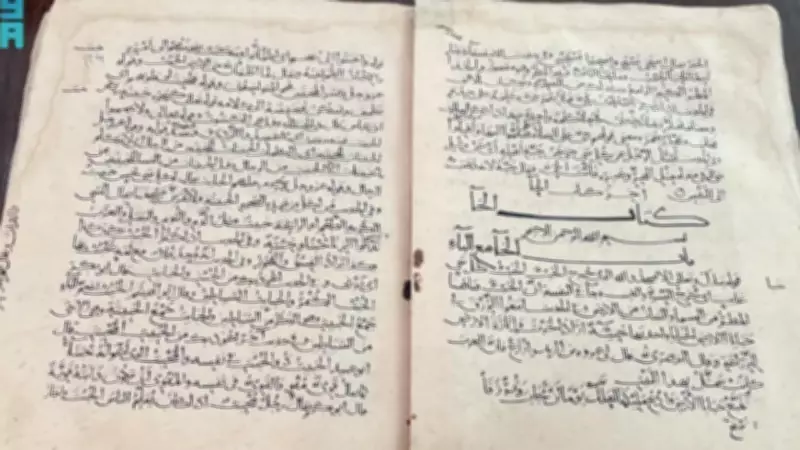
The manuscript, formally titled "Gharib Al-Qur'an" which translates to "Rare Terms in the Qur'an," was officially presented to the public by the prestigious King Abdulaziz Public Library. Authored by the eminent early Islamic scholar Abu Ubaidah Ma'mar ibn al-Muthanna, this work dates back to the 4th century AH (approximately the 10th century CE). It remains an unpublished text and is widely regarded as a major scholarly contribution to the specialized field of Qur'anic sciences, offering unique linguistic and interpretive insights.
Physically, the manuscript comprises 23 folios, with each page measuring precisely 17 by 22 centimeters. The text is inscribed in a distinct and clear Andalusian script, while the names of the surahs (chapters) are elegantly written in the classical Kufic script. This combination represents a fascinating blend of two prominent calligraphic traditions from the Islamic golden age, highlighting the artistic and scholarly craftsmanship of the period.

The Vast Archive of Qur'anic Scholarship at King Abdulaziz Library
The library's broader collection situates this newly revealed manuscript within a much larger and historically rich context. It houses a diverse and comprehensive array of rare Qur'anic exegesis works that span several centuries, creating an invaluable resource for researchers. Notable examples from this archive include:
- I’rab Al-Qur’an wa Ma’anih by Abu Ishaq al-Zajjaj, authored in the 5th century AH.
- Ta’wil Mushkil Al-Qur’an by Ibn Qutaybah al-Dinawari, with a preserved copy dating back to the 7th century AH.
- Significant portions of Tafsir Al-Tabari (Jami’ Al-Bayan fi Tafsir Al-Qur’an) by Al-Tabari, copied in the 6th century AH and consisting of 77 folios.
- Fi Ma’ani Al-Qur’an wa Tafsirih by Abu Bakr Muhammad al-Naqqash, comprising 113 pages and originating from the 7th century AH.
In total, the heritage archive conserves more than 185 rare manuscripts dedicated exclusively to Qur'anic interpretation. Additionally, it includes hundreds of supplementary texts covering various Qur'anic sciences such as grammar, detailed linguistic analysis, recitation methods (tajwid), and verse-by-verse interpretation. These manuscripts are systematically organized into four primary categories:
- Exegesis (tafsir)
- Recitations and tajwid
- Qur'anic sciences
- Qur'anic manuscripts or mushafs
Detailed Works Within the Exegesis Collection
Within the exegesis category alone, the collection features an impressive selection of scholarly works, including:
- Lubab Al-Ta’wil fi Ma’ani Al-Tanzil
- Al-Taysir fi Al-Tafsir by Umar Al-Nasafi
- Hall Al-Ishkalat fi Fahm Ba’d Al-Ayat, dating to the 12th century AH (17th century CE)
- Al-Bahr Al-Madid fi Tafsir Al-Qur’an Al-Majid by Ahmad ibn Ajibah
- Ma’alim Al-Tanzil by Al-Baghawi
Other critically important texts in the archive are Tafsir Al-Jalalayn, Al-Durr Al-Masoon fi ‘Ulum Al-Kitab Al-Maknun, Al-Durr Al-Manthur fi Al-Tafsir bil-Ma’thur, and Al-Jawahir Al-Hisan fi Tafsir Al-Qur’an. The collection also encompasses numerous specialized manuscripts that address the intricate linguistic, grammatical, and interpretive dimensions of the Qur'an, offering a holistic view of historical Islamic scholarship.

Broader Cultural and Academic Objectives
Through the unveiling of Gharib Al-Qur'an, the King Abdulaziz Public Library has reinforced its overarching mission of showcasing rare cultural assets, which extend beyond manuscripts to include historical documents, photographs, coins, and various artefacts. The institution is actively working to open new pathways for public and academic engagement with Islamic heritage while providing robust support for systematic scholarly research.
By meticulously preserving and thoughtfully presenting these materials, the library aims to make historically significant works more accessible to contemporary scholars and researchers. This initiative is designed to deepen and enrich the study of Qur'anic sciences across generations, fostering a continuous dialogue between past scholarship and modern academic inquiry, and ensuring that this invaluable knowledge is not lost to time.