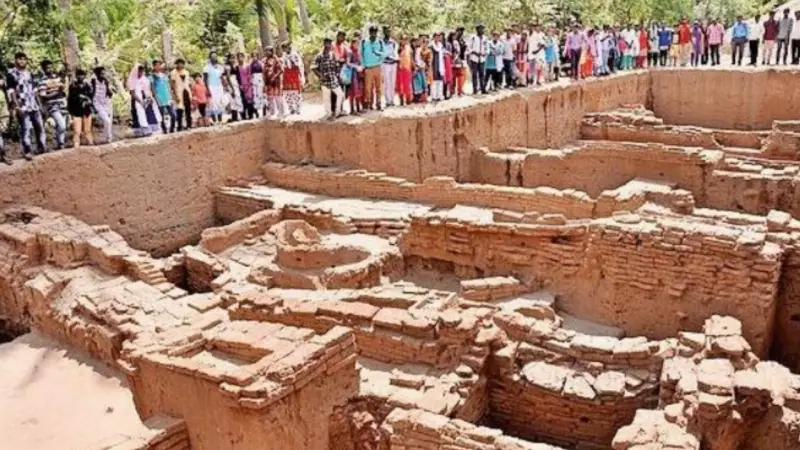
In a groundbreaking discovery that paints a vivid picture of ancient industrial prowess, scientific analysis of artefacts from the Keeladi excavation site in Tamil Nadu has confirmed the existence of sophisticated textile dyeing units dating back 2,000 years to the Sangam age. Researchers have identified plant-based pigments, including indigo and anthraquinone-based dyes, proving advanced knowledge of chemistry and materials science.
Scientific Proof of Ancient Industry
A dedicated research team from Madurai Kamaraj University (MKU) conducted a meticulous analysis of organic compounds found on pottery sherds, bricks, and soil samples from Keeladi. Using advanced Gas Chromatography-Mass Spectrometry (GC-MS) techniques, they isolated and identified 14 distinct indigo-related compounds alongside significant anthraquinone molecules.
Professor G Kumaresan, head of the department of genetics at MKU's school of biological sciences, stated that the different indigo compounds clearly point to the use of plant-based dyes two millennia ago. This finding is further bolstered by the archaeological context of the site, which includes furnace-like structures with terracotta channels and ceramic vessels, indicating a specialized installation for controlled heating and liquid management.

Linking Local Sources to Global Practices
The discovery places Keeladi's ancient artisans in a global historical context. Anthraquinone-based dyes, like those identified, were also used in ancient Egyptian textiles, Roman fabrics, and medieval European cloth. Notably, similar madder-based dyes have been found on cotton textiles from the Indus Valley sites of Mohenjo-daro and Harappa.
Professor K Rajan, academic and research adviser for the Tamil Nadu Department of Archaeology, emphasized the importance of the study. "Besides the archaeological findings, this gives us the scientific proof that a textile dyeing unit functioned at Keeladi," he said. The evidence aligns perfectly with artefacts like spindle whorls and bone points found at the site, as well as descriptions of dyeing processes in ancient Sangam literature.
Unearthing the Botanical and Technological Secrets
The research is now delving deeper to identify the exact botanical sources of these ancient dyes. The most likely candidates are plants like Indian Madder (Rubia species or Chay root), Morinda, or Senna. Supporting this local connection, the Botanical Survey of India (BSI) has documented the natural occurrence of Indian Madder in nearby regions such as the Alagar Hills in Madurai and the Piranmalai Hills in Sivaganga.
The MKU genetics team is currently working to detect ancient plant DNA traces from associated soil samples, which could pinpoint the precise plants used. This multidisciplinary approach confirms that Keeladi was far more than a residential settlement. "It was an industrial centre where knowledge of chemistry, heat control, plant processing, and materials science was applied," Professor Rajan concluded. Ongoing scientific investigations aim to identify the types of textiles dyed and fully reconstruct the ancient textile technology of this vibrant Tamil civilization.