

Arpan Sadhukhan's Exhibition 'Death Is Nothing But Love' Explores Consumer Identity Contradictions
Through an immersive collection of dense woodcut prints, intricate drawings, and compelling sculptural works, Kolkata-born artist Arpan Sadhukhan's solo exhibition Death Is Nothing But Love offers a profound reflection on the inherent contradictions of contemporary existence. Currently captivating audiences in Hyderabad, this thought-provoking exhibition delves deep into how pervasive systems of consumption actively mold individual identity, interpersonal relationships, and the fundamental ways people engage with the surrounding world.
A Meditation on Love and 'Self-Death'
At the conceptual heart of the exhibition lies a powerful paradox encapsulated by its evocative title, which is derived from the poignant poem This Valley of Death Is No Country of Mine by celebrated Bengali writer Nabarun Bhattacharya. For Sadhukhan, this title perfectly captures the dualities of living within societal frameworks increasingly dominated by relentless market forces.
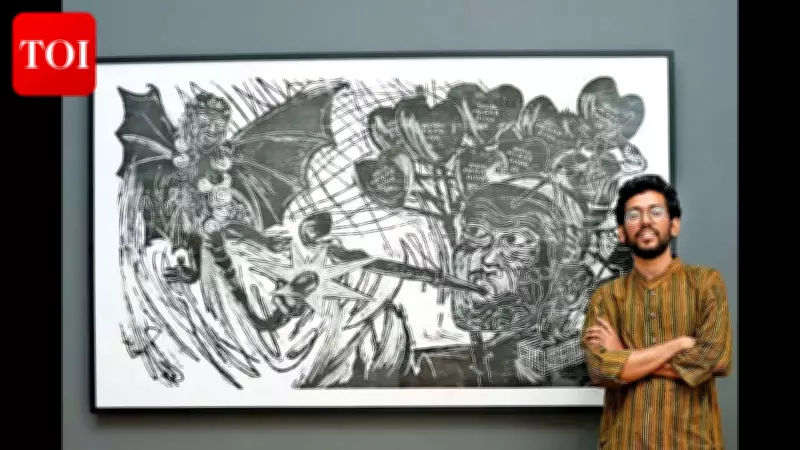
"We are living in a time where we willingly participate in systems that slowly erase parts of our identity," the artist explains. "In a way, that becomes a kind of 'self-death'. Yet we participate in this process willingly — we even enjoy it. So in that sense, the 'death' I am referring to is something we are loving and embracing every day." This central theme is vividly expressed through a striking woodcut sculpture prominently displayed at the Hyderabad venue, serving as a tangible manifestation of this complex idea.

Visualizing the Contradictions of the Present
The artworks featured in the exhibition are characterized by exceptionally dense compositions and richly layered imagery, often revealing multiple forms and narratives within a single, unified frame. For Sadhukhan, this deliberate visual intensity directly mirrors the intricate complexity of the subject matter he is passionately exploring.
"The subject I am working with is itself full of contradictions," he states. "Even as an artist critiquing consumer culture, I am not outside of it." This acknowledgment of personal complicity adds a layer of authenticity and introspection to the work.
Rather than presenting static, fixed images, many of Sadhukhan's pieces are designed to unfold gradually as viewers dedicate time to engage with them. "At first glance you might see one figure, but if you look closely there are many other forms emerging from within it," he elaborates. "The time we are living in is complex and difficult to navigate, and through my work I am simply trying to express the turmoil of our time." This approach is exemplified by a meticulously carved woodcut work on display, which invites prolonged observation and discovery.
The exhibition stands as a significant cultural event, highlighting the ongoing dialogue between art and societal critique. It challenges audiences to reflect on their own roles within consumer systems while appreciating the technical mastery and conceptual depth of Sadhukhan's artistic practice.






