ASI Grants Permission for Major Archaeological Excavations Across Tamil Nadu
The Archaeological Survey of India (ASI) has officially authorized the state archaeology department of Tamil Nadu to proceed with excavations at Keeladi for its highly anticipated 11th season, along with seven additional significant archaeological sites. This comprehensive approval spans a full year, enabling researchers to delve deeper into the region's ancient history.
Unprecedented Scale of Excavations
With this latest authorization, a total of 13 archaeological sites across Tamil Nadu will undergo excavation simultaneously. This represents the highest number of concurrent excavations in the state within a single year over the past six decades, marking a significant milestone in Indian archaeology.
Sources within the state archaeology department have confirmed that excavation work will commence promptly. Tamil Nadu operates within a limited excavation window, typically concluding by September before the monsoon season begins. "We are actively preparing to initiate fieldwork as soon as possible to maximize our research period," explained a department official.

Research Objectives and Historical Significance
The primary research goals for this year's excavations include uncovering more evidence about ancient iron technology and maritime trade networks that existed in the region. "Through meticulous excavation and analysis, we aim to reconstruct aspects of technological advancement and commercial exchange that shaped early Tamil society," stated a source from the archaeology department.
Seven Additional Approved Excavation Sites
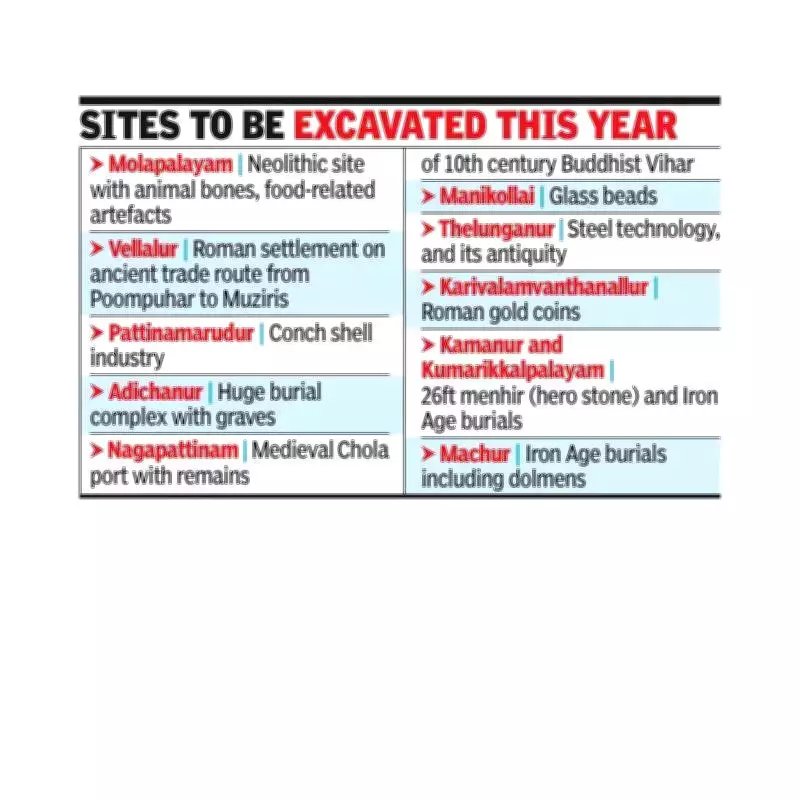
The ASI has approved excavation proposals for seven other historically significant locations across Tamil Nadu:
- Nagapattinam: The renowned Chola-era port city that served as a crucial maritime hub
- Manikollai in Cuddalore district: A Sangam-era center specializing in glass bead production
- Vellalur in Coimbatore and Karivalamvanthanallur in Tenkasi: Sites that have previously yielded valuable Roman gold coins
- Adichanur near Tirukoyilur: An important Iron Age burial site
- Thelunganur near Salem: Another significant Iron Age settlement location
- Pattinamarudur in Tuticorin: A historical conch shell ornaments manufacturing unit
Keeladi's Continuing Archaeological Mysteries
While scholarly debate continues regarding the precise antiquity of Keeladi, particularly as the ASI has yet to publish archaeologist Amarnath Ramakrishna's comprehensive excavation report, the state archaeology department has independently radiocarbon-dated a sample from the site to approximately 580 BCE.
Recent scientific investigations at Keeladi have revealed fascinating discoveries, including traces of indigo dye, providing concrete evidence of an ancient dyeing unit's operation. Furthermore, with assistance from a specialized laboratory in the United Kingdom, researchers have successfully reconstructed the facial features of two men believed to have lived in the area approximately 2,500 years ago.
Additional Excavation Initiatives Across Tamil Nadu
Beyond the state archaeology department's projects, the ASI is conducting its own excavations at two Iron Age sites: Kamanur near Thandikudi in Kodaikanal and Kumarikkalpalayam in Tirupur district.
Three academic institutions have received excavation permissions as well:
- The University of Madras and Tamil University will investigate Neolithic sites at Chettimedu Pathur near Chengalpet and Molapalayam near Coimbatore
- Researchers from the Indian Institute of Technology Bombay will excavate Machur near Kodaikanal, an Iron Age burial site of archaeological significance
This expansion of archaeological activity follows earlier concerns raised by Tamil Nadu Chief Minister M. K. Stalin regarding delays in ASI approval processes, with some excavation proposals reportedly pending for over six months before receiving authorization.