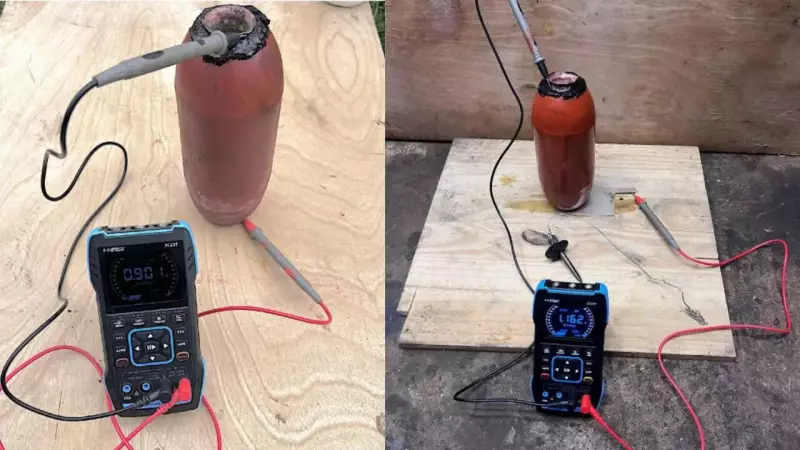
The Enduring Enigma of the Baghdad Battery
For decades, the Baghdad Battery has occupied an uncomfortable position within archaeological circles. Discovered at the Parthian site of Khujut Rabu near Baghdad, this artifact dates back to approximately the first century CE and continues to defy simple classification.
A Deceptively Simple Construction
The object itself appears straightforward at first glance: a clay jar containing a copper tube, with an iron rod held securely in place using bitumen. While each component was common in ancient times, their specific combination creates something far more puzzling. From its initial discovery, the arrangement has borne an uncanny resemblance to basic electrochemical cells—a similarity that persists despite numerous attempts to explain it otherwise.
Recent experimental investigations have not provided definitive answers, but they have redirected attention toward subtle design features that were previously overlooked. These details suggest the Baghdad Battery may have been significantly more powerful than earlier reconstructions indicated.

Precision Engineering or Mere Container?
According to Alexander Bazes' research detailed in The Baghdad Battery: Experimental Verification of a 2,000-Year-Old Device Capable of Driving Visible and Useful Electrochemical Reactions at over 1.4 Volts, the iron rod sits precisely inside the copper cylinder without making contact. This deliberate spacing allows for liquid containment, while the sealed top limits movement and prevents accidental contact.
These are not random design choices. The configuration doesn't easily align with theories suggesting the object served merely as a scroll holder or sacred vessel. Nothing about its construction suggests it was meant for frequent opening and closing. Instead, it appears assembled to remain intact while facilitating some internal process.
The Limitations of Early Reconstructions
When twentieth-century researchers first attempted to reconstruct the Baghdad Battery, the results proved disappointing. Early replicas generated only minimal voltages—barely detectable levels that critics cited as evidence against the battery hypothesis. If ancient people had intentionally created this device, why would they build something with such negligible output?
These initial reconstructions presented another problem: they treated the ceramic jar as a passive container rather than an active component of the system. This oversight may have fundamentally limited understanding of the artifact's true capabilities.
Reevaluating Materials and Mechanisms
More recent investigations have taken a meticulous approach to analyzing the original materials. Traces of solder and evidence of interactions between the clay vessel, moisture, and atmospheric conditions suggest more complex processes may have been at work.
A compelling new interpretation proposes that the Baghdad Battery actually functioned as a dual electrochemical system. In this model, the copper and iron components create one small cell, while the clay jar and surrounding materials form another. When connected, these systems could potentially generate voltages exceeding those achieved in earlier experiments—possibly reaching over 1.4 volts according to recent findings.
Observable Effects and Practical Applications
Once voltage crosses a certain threshold, tangible changes become apparent. Metal surfaces undergo transformation, gas bubbles form in liquids, and colors visibly shift. These are not subtle phenomena requiring sophisticated instrumentation to detect. Anyone observing the process would recognize something repeatable was occurring.
Whether ancient users understood these effects as electricity, chemistry, or something else entirely remains uncertain. What's clear is that the outcomes would have been impossible to ignore.
Patterns Suggesting Deliberate Practice
The Khujut Rabu discovery is not an isolated anomaly. Archaeologists have recovered similar jars with metal components at multiple Iraqi sites dating from roughly the same period or slightly later. While not identical, these artifacts share the same basic configuration—copper, iron, and ceramic arranged in specific relationships.

This repetition across time and location strongly suggests intentional design rather than accidental arrangement. It hints at a technological practice that circulated within certain communities, possibly without formal documentation.
Unresolved Questions and Competing Theories
The scientific community remains divided about the Baghdad Battery's original purpose. Some researchers favor ritual explanations, where visible electrochemical reactions might have served ceremonial or display functions. Others propose practical workshop applications, such as metal finishing or surface treatment processes.
The artifact itself doesn't compel a single interpretation. Its materials behave in ways that can be experimentally verified, yet its archaeological context remains fragmentary. The gap between what the device could do and why ancient people created it persists, resisting easy closure.
A Legacy of Scientific Curiosity
The Baghdad Battery continues to resist neat categorization. It exists in that fascinating space between clearly symbolic artifact and fully explained tool. Its materials invite testing, its context challenges interpretation, and its very existence prompts us to reconsider assumptions about technological development in ancient civilizations.
As research continues, this 2,000-year-old device reminds us that history often contains more complexity than our modern categories can comfortably contain. The mystery endures not because of missing evidence, but because the evidence we have points in multiple directions simultaneously—a testament to the sophistication of ancient craftsmanship and the enduring human capacity for innovation.