The Banyan Tree: India's Majestic 'King of Trees' and Its Enduring Legacy
Trees have always been an integral part of human civilization, serving countless purposes from providing protection and food to offering shade and life-sustaining oxygen. Among the vast diversity of tree species worldwide, one stands out for its remarkable size, endurance, and profound significance: the Banyan Tree, scientifically known as Ficus benghalensis, widely revered as the "King of Trees."
Why the Banyan Tree is Called the King of Trees
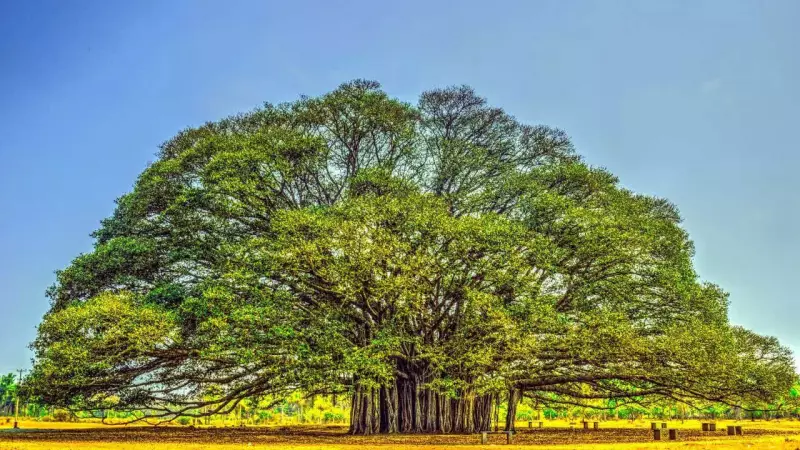
The Banyan Tree earns its royal title due to its vast canopy, sprawling roots, and self-sustaining nature that supports numerous living organisms. Unlike ordinary trees, its branches develop aerial roots that grow downward, anchoring in the soil to form secondary trunks. This unique growth pattern allows a single tree to spread over extensive areas, often resembling a small forest. Its imposing presence and sheltering shade have made it a symbol of permanence, strength, and protection.
Unique Growth Patterns and Structural Marvel
The Banyan Tree exhibits one of the most fascinating growth mechanisms in the plant kingdom. Its large aerial roots emerge from branches and gradually thicken into new trunks, supporting the expansive canopy above. Over time, this enables the tree to spread both horizontally and vertically across large land areas. This structural adaptation not only enhances its strength but also contributes to its ability to survive for centuries. The potential for indefinite expansion has led many cultures to view the Banyan as a symbol of eternal life.

Longevity and Vital Role in Supporting Ecosystems
One of the most astonishing traits of the Banyan Tree is its exceptional longevity. These trees typically live for several hundred years, with some ancient specimens in India estimated to be over two centuries old. A notable example is the Great Banyan Tree in Howrah, West Bengal, which spans more than three acres and continues to thrive despite its age. This remarkable lifespan underscores its association with endurance and stamina, further justifying its "kingly" status.
Beyond its size and age, the Banyan Tree plays a crucial ecological role. Its sprawling canopy creates a micro-ecosystem, offering a cooling effect and shielding humans, animals, and plants from harsh sunlight. The figs produced by the tree serve as a vital food source for birds, bats, insects, and other wildlife, sustaining diverse life forms. Additionally, birds and small mammals find habitats in its aerial roots and trunks, fostering a rich ecosystem centered around a single tree.
Cultural and Spiritual Significance in Indian Traditions
In Indian culture, the Banyan Tree transcends mere natural wonder, embodying knowledge, longevity, and safeguarding. Indian mythology is replete with legends linking the tree to divinity and eternal life. It is often depicted as a sacred site where saints meditate and communities gather. The tree's broad shade serves as a traditional meeting place in villages for rest, storytelling, and local discussions. Its designation as the "National Tree of India" highlights its deep-rooted importance in the nation's heritage.
Distribution, Habitat, and Ecological Impact
Native to the Indian subcontinent, including India, Sri Lanka, Nepal, and Bangladesh, the Banyan Tree thrives in tropical and subtropical regions. It commonly grows along roadsides, in villages, near temples, and on open lands, reflecting its integral role in human settlements. As a biological fortress, it supports various species: its fruits nourish birds and insects, while its root systems offer resting spots for small mammals. The tree provides shelter for creatures like monkeys and squirrels, making it a hub of biodiversity and a lifeline for dependent species and plants.
The Banyan Tree symbolizes strength, unity, and resistance, much like it provides shelter to countless species. Its ability to endure for ages also represents wisdom and resilience in human systems, making it a timeless emblem of nature's grandeur and cultural heritage.