

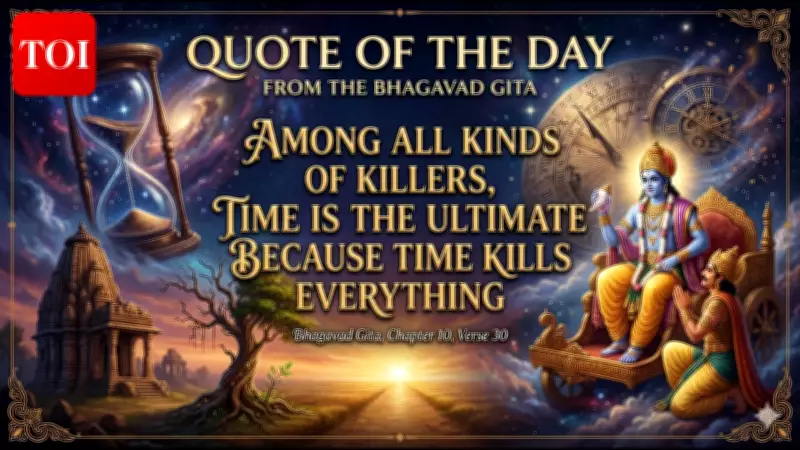
The Bhagavad Gita: A Timeless Spiritual Dialogue
The Bhagavad Gita stands as one of India's most revered and frequently referenced spiritual manuscripts. This sacred text continues to captivate and inspire countless individuals with its profound philosophical insights and ethical teachings. Remarkably, the entire scripture is structured as an extended conversation between Lord Krishna and the warrior Arjuna, set against the backdrop of the epic Kurukshetra war.
The Context: Krishna's Guidance to Arjuna
Each verse within the Bhagavad Gita encapsulates the motivational and enlightening words spoken by Lord Krishna to Arjuna, who grappled with a profound moral dilemma on the battlefield. Their extensive dialogue delves deeply into essential concepts including duty (dharma), righteousness, the nature of life and death, and the fundamental structure of the universe. A particularly powerful verse from this text serves as today's featured quote, offering significant wisdom about time and destruction.
The Sanskrit Verse and Its Translation
Sanskrit Quote: कालोऽस्मि लोकक्षयकृत् प्रवृद्धो

Transliteration: Kālo'smi loka-kṣhaya-kṛit pravṛiddho
English Meaning: "I am Time, the mighty destroyer of worlds." This profound statement is often philosophically interpreted as "Among all kinds of killers, time is the ultimate because time kills everything."
Philosophical Significance of the Verse
In this specific verse, Krishna reveals his universal form to Arjuna and explains that time represents the supreme force responsible for the eventual destruction of all beings. Every living creature, every empire, and every civilization ultimately succumbs to the relentless and constant flow of time. The verse powerfully emphasizes that time spares absolutely nothing, thereby establishing it as the most formidable "killer" in existence.
The Core Meaning of the Quote
This quote articulates a fundamental reality of the material world: everything within it is inherently temporary and transient. Birth inevitably leads to death, growth naturally progresses into decay, and even humanity's greatest achievements and monuments will one day fade into oblivion. The verse declares that time operates as the ultimate game-changer in every individual's life, shaping destinies and erasing legacies.
Interpretation and Practical Teachings
The verse supports multiple philosophical interpretations according to various scholarly perspectives. The primary lesson teaches the essential practice of humility. The Bhagavad Gita demonstrates that all achievements, ambitions, and material possessions accumulated through human effort will eventually be lost to the passage of time. This realization naturally fosters a sense of modesty and perspective.
The teaching establishes its second crucial point through the practice of detachment. Since everything possesses only a limited temporal existence, individuals should focus their energies on fulfilling their duties with sincere dedication and integrity, rather than becoming excessively attached to material outcomes or rewards. This approach encourages living purposefully while maintaining spiritual equilibrium.
The Bhagavad Gita's enduring relevance lies in its ability to address universal human concerns through timeless wisdom. Krishna's declaration as Time serves as a powerful reminder to prioritize spiritual growth and ethical action in a world where all material forms are impermanent.






