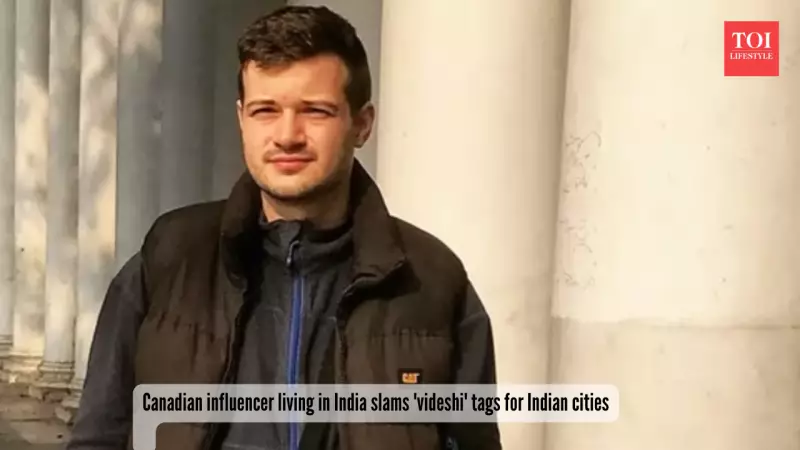
A Canadian influencer who has made India his home for eight years has sparked a significant conversation about how Indians label their own landmarks. Caleb Friesen recently took to social media platform X to voice his frustration with what he calls an "illogical" trend.
The Core Criticism: Why Compare India to Foreign Places?
Friesen specifically targeted the common practice of describing Indian locations with foreign tags. He mentioned popular nicknames like "Switzerland of India," "Scotland of the East," and "Mini Europe." According to him, these labels make Indian places appear as mere copies rather than unique destinations with their own character.
"I just think more people need to have this mindset. India is not the X of Y. India just is," Friesen stated emphatically in his video. He emphasized that India possesses its own spectacular and one-of-a-kind identity that requires no external validation.

Bengaluru's Example and the 'Silicon Valley' Tag
Friesen used Bengaluru as a primary example to illustrate his point. The city often earns the title "Silicon Valley of India" due to its thriving tech industry. However, Friesen pointed out a geographical irony. Bengaluru sits on the Deccan Plateau, which is fundamentally "the opposite of a valley."
He contrasted this with China's Shenzhen, a global tech hub that operates under its own name without borrowing from American references. This comparison highlights his argument for originality in branding and self-perception.
Beyond Geography: A Cultural Commentary
The influencer's critique extended beyond travel destinations. He also questioned the naming conventions within India's film industries, such as Bollywood and Tollywood. Friesen suggested these names unnecessarily chase the shadow of Hollywood.
"Bro, you need to stop at the woods," he remarked, pointing to South Korea's film industry as a positive example. South Korean cinema uses its own distinct identity without relying on Western comparisons, achieving global recognition on its own terms.
Why This Message Resonated Deeply
Friesen's video gained rapid traction across social media platforms. It tapped into a broader discussion about national pride and self-worth. Many users saw his comments as a timely reminder to value India's inherent strengths.
He referenced a recent exchange involving Zomato CEO Deepinder Goyal to strengthen his argument. When a fan requested a "Bryan Johnson replica in India," Goyal emphasized the importance of originality over imitation. This incident underscores that the issue spans tourism, technology, and cultural expression.
Social Media Reactions: A Mix of Support and Reflection
The response to Friesen's post was overwhelmingly positive, with users expressing strong agreement. One comment read, "Good one, India shouldn't benchmark everything against one. India is great on its own with a massive population."
Another user noted, "A pity that this has to come from a Canadian, but that isn’t bad, because sadly some Indians pick up an idea only when non-Indians approve it." This observation touches on complex post-colonial attitudes.
Several comments called for greater self-confidence. "Finally someone said it. We need to own our identities and not cling to western validation," wrote one supporter. Others praised Friesen for highlighting India's untapped potential, with a fan adding, "Well put. India needs to UP their PR game. India is so so much better than what the sentiment is like outside."
Addressing Underlying Issues
Some responses pointed to practical challenges behind the naming trend. One user mentioned, "India has many beautiful places. But because of bad infrastructure and lack of promotion, we never get to see such places that exist in India." This suggests that foreign comparisons might sometimes stem from inadequate domestic branding.
Others linked the habit to historical influences, stating, "India was first colonised for 200 years by Brits and then a 100 more colonised us mentally." This perspective frames the issue as part of a longer struggle for cultural and psychological independence.

Friesen's critique ultimately serves as a call to action. It urges Indians to celebrate their country's vibrant mosaic of cultures, dynamic growth, and historical depth without relying on foreign benchmarks. His message reinforces that India's true magic lies in embracing its own unique identity, standing confidently on the global stage as itself, not as a comparison.