Kolkata's Chinese Community Breathes New Life into Historic Achipur Temple
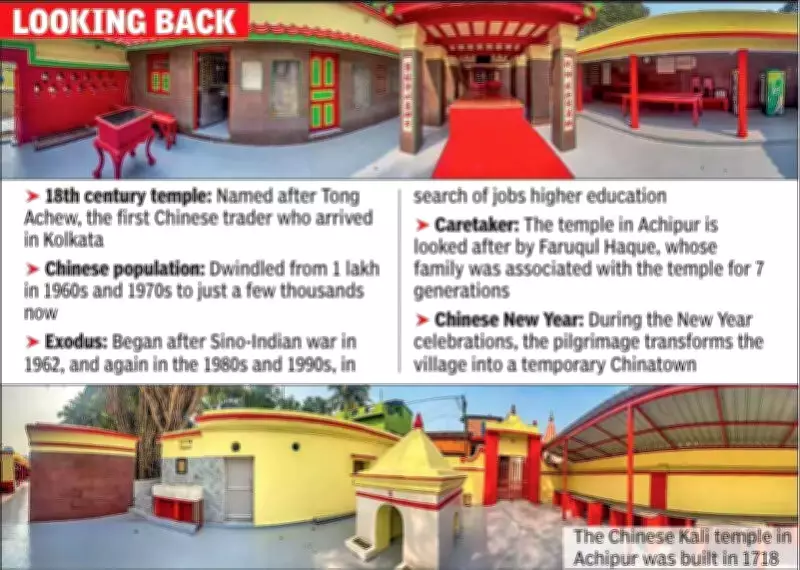
In a remarkable act of cultural preservation, the Chinese community in Kolkata has successfully restored the historic Achipur Temple on the city's outskirts, just in time for the Chinese New Year celebrations. This over 300-year-old structure, which had fallen into disrepair for several years, now stands rejuvenated as a testament to the enduring legacy of Kolkata's first Chinese settlers.
A Monument to History and Heritage
The temple, originally constructed in 1718, holds immense historical significance as it marks the site of Kolkata's inaugural Chinese settlement. This community was founded by Tong Achew, the first-known Chinese trader to arrive in India. Achew not only established sugarcane cultivation and a sugar manufacturing plant in the area but also employed numerous Chinese workers who had migrated to India. The village of Achipur itself derives its name from this pioneering figure.
Community-Led Restoration Effort
The restoration project was spearheaded by members of the Gee Hing Club, based in the Tiretta Bazar area of central Kolkata, which is responsible for the temple's upkeep. Michael Hsieh, a club member, recounted the journey: "Initially, six of us decided to restore the temple and started the work in September. Gradually, many people joined in and contributed. Finally, the restoration was completed just before the new year."

Christopher Ian Alpin, a community member who meticulously documented the entire restoration process over the past few months, described the transformation as "remarkable." He emphasized the emotional aspect of the project: "The temple was crumbling, but the determination of the Chinese community members from Gee Hing Temple on Black Burn Lane, who are the caretakers of the Achipur Temple, was unshakeable. I wanted to capture not just the physical restoration, but the emotional one. You can see the happiness on people's faces when they visit the temple."
A Symbol of Resilience Amid Decline
For Kolkata's Chinese community, this restoration marks a poignant moment. Their numbers have dwindled dramatically from nearly 100,000 in the 1960s and 1970s to just a few thousand today. This decline began after the Sino-Indian war in 1962, which fostered feelings of alienation within the once-thriving community. A subsequent wave of migration in the 1980s saw many families relocating to countries like Australia and Canada in pursuit of better job opportunities and higher education.
More recently, the closure and relocation of tanneries from Tangra further diminished employment prospects, triggering another exodus. Despite these challenges, the community's spirit remains strong. Janice Lee, a Chinese entrepreneur, articulated this sentiment: "We are small in numbers now, but our roots run deep. Restoring this temple isn't just about preserving a bricks-and-mortar structure. It is about telling our progeny where we began, and the invaluable economic and cultural contribution to the city."
Transformation During Festive Seasons
Although the settlement Achew established once made Achipur a vibrant Chinese hub, no Chinese families reside there today. The temple's daily maintenance is handled by Faruqul Haque, whose family has served as caretakers for seven generations. However, during Chinese New Year, the quiet hamlet undergoes a magical transformation into a temporary Chinatown. Chinese families from across Kolkata and beyond embark on an annual pilgrimage to the temple, infusing the area with festive energy.
"When Chinese New Year comes, this place transforms," Lee observed. The community currently funds the temple's upkeep through local contributions. Additionally, the Gee Hing Club is actively promoting Achipur as a heritage tourism destination, aiming to highlight this unique facet of Kolkata's diverse history and attract wider attention to its cultural significance.